Why mixed loads fall through the cracks
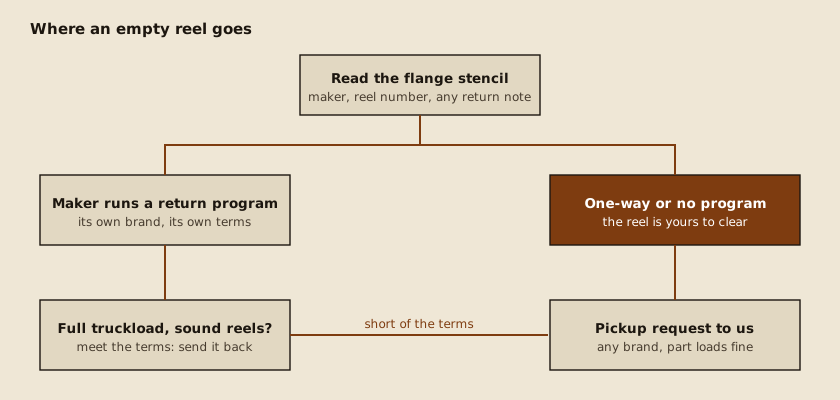
Manufacturer take-back programs are built around the maker's own reels, in good condition, usually by the full truckload. That's reasonable for them: they want reels they can inspect and refill. For the person holding a mixed stack, it means sorting by brand, counting, checking condition against each maker's rules, and still being left with everything that doesn't qualify.
As one example of how specific those rules get, Service Wire's free return program takes only Service Wire-labelled nailed wood reels with 30 to 72 in flanges, by the full truckload, with at least 75% of the drum staves intact and undamaged arbor and drive holes. Southwire runs a return program with its own pick-up request form and a separate policy for steel reels. Encore Wire, the McKinney building-wire maker, has no published reel take-back program, so its one-way reels stay with whoever emptied them.
What a mixed load looks like to us
| In the stack | What we do with it |
|---|---|
| Sound nailed reels, any brand | Count, size and buy where there's demand for that size |
| Plywood reels in good shape | Buy or take for reuse, depending on size |
| Returnable reels you'd rather not ship back yourself | Take them with the rest, or leave them for the maker's program, your choice |
| One-way reels marked non-returnable | Buy or recycle; they have nowhere else to go |
| Steel reels | Sort apart for return, reuse or metal recycling |
| Plastic spools | Take for reuse or plastics recycling |
| Split, rotten or crushed reels | Take for wood recycling with the load |
You don't need to sort by brand before you call. Brand matters to the makers' programs; it doesn't change what we pay for a sound 48 in reel.
Part loads are normal
A part load is anything short of a full truck. For a contractor that might be eight reels after a tenant fit-out, or forty from a substation job. We plan routes across the Metroplex so part loads in the same area can share a truck, which is how a small stack in Carrollton gets collected without anyone waiting for it to grow into a full load. The fewer the reels and the farther out the site, the more likely we'll ask to time the visit with other stops nearby.
Mixed sizes on one truck
Small and large reels load differently. Reels under about 42 in can be stacked on their flanges in rows; drums of 72 in and up stand on their own and set the load height. A flatbed with a few big drums still has room for smaller reels around them, so a mixed stack often travels more efficiently than a single size would. Our guide on how many reels fit on a flatbed works through the numbers for each flange size.
Brands you'll see in DFW stacks
Building wire from makers such as Southwire, Encore Wire, Cerro and Service Wire shows up on almost every commercial job. Data and control cable arrives on smaller plywood reels from a long list of suppliers. Utility cable from Okonite, Prysmian, General Cable and others tends to come on bigger nailed reels and drums. Reels are often made by a separate reel company, and a single maker's reels can come from several reel plants, so even "one brand" can mean several builds. We look at each reel's build, size and condition rather than the name stencilled on the side.
What we ask for
The count, a rough split by flange size, and a couple of photos of the stack. If you know the brands, mention them, mainly so we can flag any reels that would be better returned to their maker. If you don't know, the photos tell us.
Questions
Do I need to separate reels by brand?
No. Separate any you plan to send back to the maker yourself, and leave the rest together.
Is there a minimum number of reels?
No fixed minimum. Small loads are timed with other pickups nearby, so they may wait a little longer for a date.
Will you take reels that a maker would take back?
Yes, if you'd rather not deal with the program. We'll point out the ones that qualify so you can choose.
Request a pickup or a quote
Count and flange size are the two things that matter. The rest helps us plan the truck.