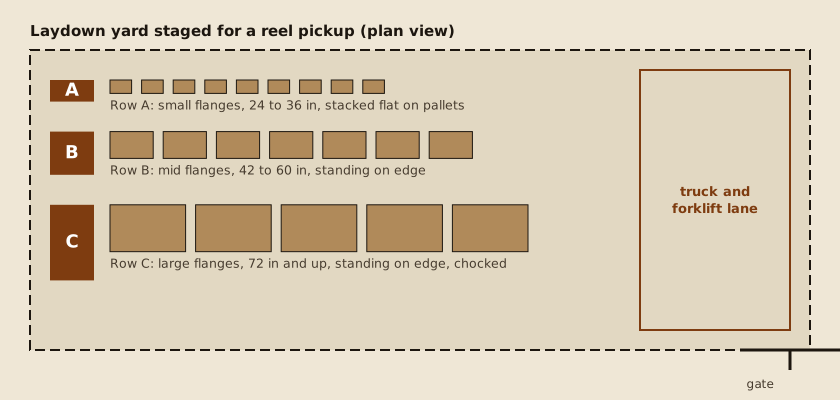
Where to put them
- Next to a truck lane. A flatbed needs a straight approach, room to stop alongside the reels, and space to pull away. A 48 ft trailer and its tractor run to roughly 70 ft, so allow a straight lane longer than that.
- On firm, level ground. Concrete or compacted gravel is best. Soft dirt swallows forklift wheels and makes reels lean.
- Clear overhead. Watch for power lines, branches and canopies. A loaded flatbed with reels standing on their flanges is tall: roughly 60 in of deck height plus the flange diameter.
- Away from the work. Don't stage where trades need to pass, park or dig.
How to set them out
- Sort by size. Group the same flange sizes together. It speeds up loading and lets us plan the deck.
- Stand them up. Reels on their flanges load fastest. Lay reels flat only if they must be stored for a long time, and then only on a firm base.
- Make rows. Line reels up in rows parallel to the truck lane, arbor holes in line, with a forklift's width between rows.
- Leave a gap at the ends. So tines can get under the end reels without hitting a fence or a wall.
- Separate the broken ones. Put damaged reels in their own row. They load last and go to recycling.
- Pull off any cable tails. Leftover cable belongs to you, and cut ends snag straps and gloves.
Storing empties while you wait
| Do | Don't |
|---|---|
| Stand reels on dunnage or pallets, off the ground | Leave reels standing in puddles or on dirt |
| Chock the end reels of each row | Leave reels free to roll on a slope |
| Keep rows tidy and walkable | Stack standing reels on top of each other |
| Keep returnable reels apart, with their paperwork | Mix someone else's returnables into a pickup |
| Book a pickup before the pile outgrows the space | Let empties block your laydown yard |
A reel kept off wet ground can stay sound for months. One left in mud through a Texas spring may not be worth reusing by summer.
On the day
Have someone on site who knows where the reels are and can sign off on the count. Tell us about gates, access hours, height limits and site rules when you book, so the right truck comes. If your site has its own forklift and a driver who can help, say so: it changes the equipment we bring. Our page on how pickup works walks through the visit, and reels on a flatbed explains what fits on one truck.
For recurring pickups
Branches, plants and utility yards that empty reels every week benefit from a fixed staging area. Mark it out, keep it clear, and book pickups on a schedule. A standing area that's always in the same place means the driver knows the site, and loads go faster each time.
Book the pickup
Tell us the count, the sizes and where the reels are staged. Photos of the rows help.
Request a pickup or a quote
Count and flange size are the two things that matter. The rest helps us plan the truck.
Lighting and timing
Winter afternoons are short. If the pickup runs late, the driver needs to see the rows, the chocks and the edges of the truck lane, so leave site lighting on or stage reels under existing lights.
Neighbours
On tight urban lots, warn neighbours about the truck's arrival time and the noise of loading.
Questions
Do the reels need to be in rows?
It helps a lot, but we'll load a pile. Rows make it faster and safer.
Can reels be stored lying flat?
Yes, on a firm, dry base, for long-term storage. Stand them up for loading.
Should I separate brands?
Not for us. Only separate returnable reels that belong to someone else.