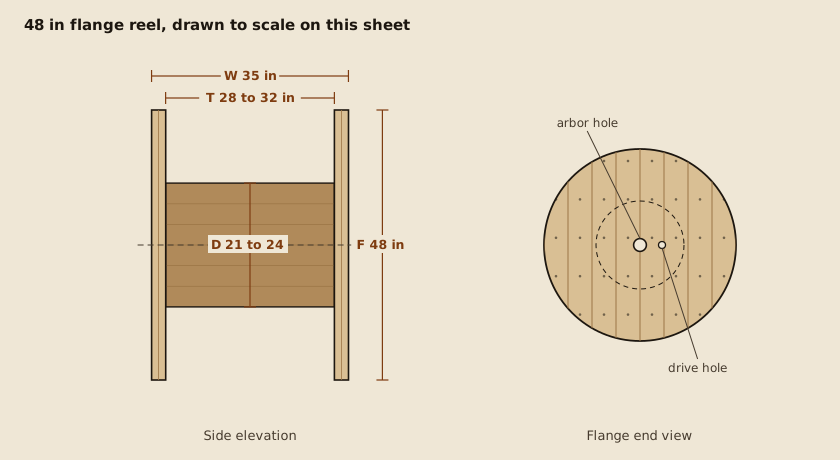
The five measurements
- Flange diameter (F). Stand the reel up. Hook the tape on the rim of one flange and run it across the face, through the centre of the arbor hole, to the opposite rim. That's the reel's size: a 48 in reel has a flange about 48 in across.
- Traverse (T). Measure the inside gap between the two flanges, across the drum. This is the width the cable or rope has to fit into.
- Drum diameter (D). If the drum is bare, measure across it. If you can't reach, measure around it and divide by 3.14.
- Overall width (W). Outside face of one flange to the outside face of the other. Add a little for bolt heads or protruding nails.
- Arbor hole. The diameter of the hole through the centre, where a shaft or reel stand goes.
Writing it down
Reel tables write a reel as F × T × D. So "36 × 24 × 17" means a 36 in flange, a 24 in traverse and a 17 in drum. Okonite's published table, for example, lists that reel at an overall width of 28.5 in and an empty weight of 77 lb. If you send us three numbers in that order, we know what you have.
Example dimensions: The Okonite Company, Technical News Edition 33, "Reel Anatomy", November 2016.
How accurate it needs to be
| Why you're measuring | How close is close enough |
|---|---|
| Booking a pickup of empties | Flange to the nearest few inches, and a count |
| Selling a stack | Flange and traverse, to the nearest inch |
| Buying a reel for a table | Flange and overall width, since they set the top and the height |
| Winding cable or rope | All five, to the nearest half inch, plus the reel's rated load |
| Matching reels for a payoff line | All five, and the build, because makers differ |
Common mistakes
- Measuring off-centre. A tape that misses the centre reads short. Line it up through the arbor hole.
- Using the overall width as the traverse. The flanges can be 2 to 4 in thick each on a large nailed reel; the difference matters.
- Rounding to the wrong size. A flange that's 46 or 50 in across is still likely sold as a 48 in class reel, but say what you measured.
- Ignoring the flange edge. Chipped or worn rims make a flange read small. Measure in two directions and use the larger.
Measuring a stack you can't reach
Reels stacked flat or crowded together are hard to tape. Measure one you can reach, then compare the rest by eye: same stencil, same build, same height on the stack. Photos taken square to a flange, with the tape in the picture, are as good as a measurement for a quote.
What a measurement tells you
Flange size sets how many reels fit on a truck and roughly what they weigh. Traverse and drum set what the reel can hold. Overall width is the height of a spool table, and the space a standing reel takes along a truck deck. That's why we ask for flange size and a count first, and the rest only when it matters.
Tools that make it easier
A 25 ft steel tape covers everything up to 96 in reels. For big reels, a second person holding the hook end on the far rim saves a lot of stretching. A carpenter's square laid across the drum gives a cleaner traverse reading than bending the tape. A soft sewing or fabric tape is handy for measuring round a drum when you need its circumference. And a phone photo of the tape on the flange, taken square-on, records the number and the reel's build in one go.
Metric reels
Some reels, especially imported ones and plastic spools, are built to metric sizes and stencilled in millimetres. A 1,200 mm flange is about 47 in, 1,500 mm about 59 in, and 1,800 mm about 71 in. Convert by dividing millimetres by 25.4. When you send us sizes, either unit is fine, as long as you say which.
Reels lying flat
A reel lying on its flange is easier to measure in some ways: you can reach the whole top face, and the overall width is its height off the ground. Measure the flange diameter across the top face, and the height from the ground to the top flange's upper surface. For the traverse, measure the height of the gap between the flanges at the drum.
Recording a whole stack
For more than a dozen reels, a tally sheet beats memory. Make three columns: flange size, build (nailed, plywood, plastic or steel) and condition (sound, worn or broken). Make a mark per reel, then total each line. Twenty minutes with a tape and a clipboard gives a quote-ready summary, such as "14 × 48 in nailed sound, 6 × 48 in nailed broken, 22 × 30 in plywood", and that's exactly what we need to send the right truck and give a firm price.
Safety while measuring
Don't climb on a stack to reach a reel. Chock a standing reel before leaning across it, keep fingers out of the gap between flange and ground, and watch for proud nails on old flanges. Measuring big reels is a two-person job for a reason.
Questions
What's a "48 inch reel"?
A reel whose flanges are about 48 in in diameter. The traverse and drum vary by builder.
Do I measure inside or outside the flanges?
Both: the traverse is inside, the overall width is outside.
What if the drum is still wrapped in cable?
Measure the flange and traverse; the drum can wait.