Where plywood reels come from
Wire makers ship lighter products on plywood reels because they're cheap to build, light to ship and nest well on a truck. THHN building wire, MC cable, data cable, control cable and low-voltage cable usually arrive on them. Distributors who cut to length empty them by the dozen. Data-centre and office jobs leave hundreds behind, often identical, because the cable came in a single batch.
The weather problem
Plywood is layers of thin veneer glued together, and its edges are end grain. Water soaks into the edges, the glue lines swell, and the layers begin to separate. A plywood reel stored under cover lasts for years. One left out through a wet North Texas spring is often peeling by summer. Once the flange starts to delaminate, the reel can't carry cable safely, and it can't be repaired economically. Keep empty plywood reels dry if you want them to be worth anything.
Bolts: the hidden cost
The bolts that make plywood reels quick to build make them slow to recycle. Each one has to come out before the wood can go to most outlets, and the glue in plywood rules out some mulch and bedding uses. That's why sound plywood reels are worth reusing wherever possible, and why a load of soaked, peeling plywood reels costs more to clear than the same number of nailed reels.
Reuse
Dry, sound plywood reels are popular with:
- Supply counters rewinding cut lengths of building wire
- Small contractors storing offcuts and spare cable
- Makers and table builders, because the flanges are flat and smooth
- Shops and markets using them as displays and stands
They're less suited to ranch and outdoor use, and to heavy cable, where a nailed reel is the better choice.
Telling plywood from boards
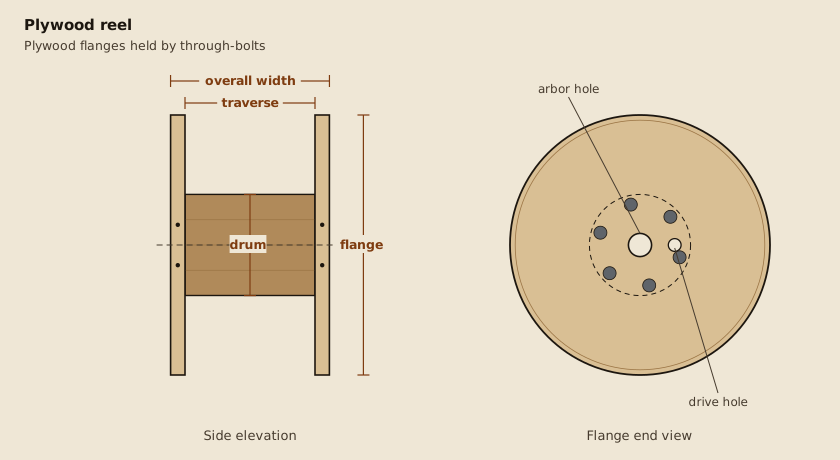
Look at the edge of a flange. Plywood shows thin layers stacked like pages in a closed book; a nailed board flange shows the ends of individual boards and the gaps between them. Plywood flanges are smooth and flat across their face; board flanges have seams. And plywood reels have a ring of bolt heads, usually four to eight, around the arbor hole, where nailed reels have rows of nail heads.
Handling plywood reels
Plywood reels are light enough that people take liberties with them. Rolling one across gravel chews the flange edge and opens it to water. Dropping one off a tailgate cracks the flange around the bolts. Stacking them flat, flange on flange, is fine if the stack is short and dry, but a tall stack crushes the lower drums. Stand them on their flanges in rows where possible, keep them off wet ground, and lift rather than drag. A reel handled this way stays reusable for several trips.
Storing a batch for resale
If you've got fifty identical plywood reels from a job, they're worth far more together than scattered. Keep the batch under a roof or a tarp, on pallets, and tell us it's a matched set when you ask for a quote. Buyers who rewind wire for customers value consistency, and a dry matched batch is one of the few plywood loads that sells well.
Thicker flanges, three-quarter inch and above, survive longer than thin half-inch ones, so check the thickness when you're comparing two batches.
Questions
Can plywood reels be left outside?
Not for long. A few weeks is usually fine; a wet season isn't.
Are the bolts reusable?
Often, if they're not rusted. They're usually threaded rod with nuts and washers.
Are plywood reels returnable?
Rarely. Most are one-way reels, which the maker doesn't expect back.