The two weights in each row are for the lighter and heavier builds Okonite lists for that size. Other makers' drums vary, and larger drums exist; Sonoco lists nailed reels up to 116 in.
How a drum differs from a smaller reel
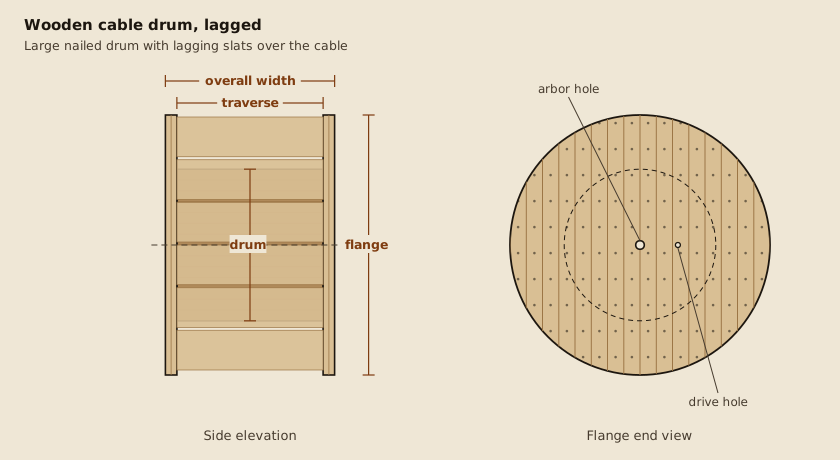
The basic build is the same as a nailed reel: board flanges, a drum of staves, nails. But everything is heavier. Flange boards are thicker and often laid in more layers. Staves are thicker and closer together. Steel arbor plates are bolted to both flanges so the reel can turn on a heavy spindle without wearing its hole. Steel tie rods often run through the drum from flange to flange to stop the flanges spreading under load. A big drum is as much a piece of equipment as a container.
What they carry
- Medium-voltage power cable for utilities, data-centre feeders and industrial plants
- Large aluminium and copper conductor for transmission and distribution lines
- Long single lengths of heavy cable where splicing should be kept to a minimum
- Wire rope, sometimes, though steel reels are more common for that
In Dallas-Fort Worth, the biggest sources of empty drums are utility and co-op projects, substations, and the feeder runs on large data-centre campuses.
Moving drums
An empty 84 in drum weighs between about 640 and 920 lb, stands taller than most people, and rolls. Drums are moved with a forklift, telehandler or crane, or rolled under control with a winch. They're loaded onto flatbeds standing on their flanges, chocked front and back and strapped through the arbor. A 48 ft flatbed takes around six of them in a single tier, and the load is tall: the flange height plus the deck height. Our guide on moving large spools covers the risks in more detail.
Worth repairing
Drums cost a lot to build new, so a drum with one cracked flange board or a loose stave is usually worth repairing. Replacement boards are cut and nailed in, plates are tightened, and the drum goes back into service for cable or rope. Drums with rot through several staves, a torn arbor or flanges pulled away from the drum are taken apart. Their thick boards make good repair stock for other reels.
Who buys empty drums
Contractors and utilities rewinding medium-voltage cable. Rope and wire rope users storing very long lengths. Ranches wanting a big reel for poly pipe. Restaurants, venues and landscapers wanting a dramatic piece. Film and event crews. The market is smaller than for mid-size reels, but steady, and a sound drum is rarely around for long.
Storing drums on a site
Drums need firm ground. Their weight sits on two narrow flange rims, and on soft soil after rain a drum sinks unevenly and tilts. Gravel pads, timber mats or concrete are best. Stand drums with enough space between them for a forklift to reach the arbor plates or the flange base, and chock each one on both sides. Never lean drums against each other or against a fence. If a drum has to stay out for months, check the tie rods and the arbor plate bolts now and then; wood shrinks in the summer heat and loosens them.
Drums as landmarks
Restaurants, breweries, landscapers and garden centres sometimes buy a single drum as a centrepiece or a sign. Because of the weight, plan its final position before delivery, level a pad of gravel or pavers, and set the drum down once.
Drum lagging is often heavier too: thick boards banded with steel strapping to protect expensive cable during shipping and storage on open ground.
Questions
Will a drum fit on a regular trailer?
No. An 84 in drum standing on its flanges is too tall and heavy for most car trailers. Use a flatbed or a lowboy.
Can a drum be used as a table?
Yes, and it makes a spectacular one, but plan for its weight and size first; it can't be moved casually once it's set down.
Are drums returnable?
Some are, especially utility reels with a deposit. Check for stencils and plates on the flange.