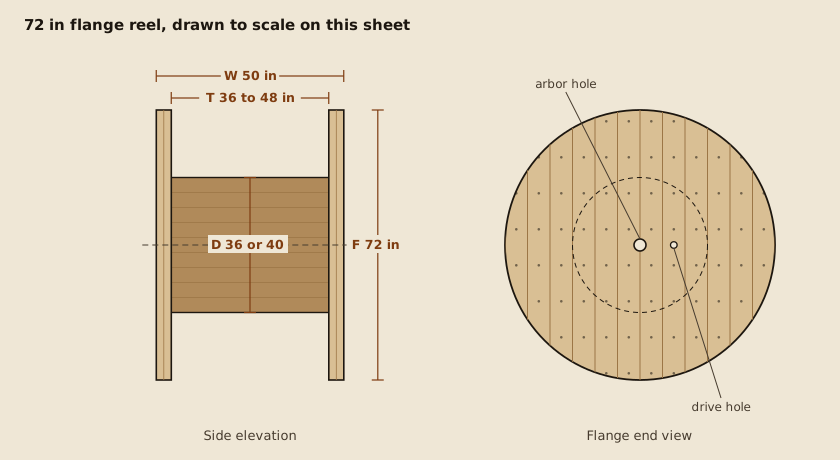
Rows read flange × inside traverse × drum. Okonite lists more builds at 72 in than at any other flange size: three traverses, two drums, and standard and heavy versions of most.
Why so many builds
Different cables need different reels at the same flange size. A cable with a large bending radius needs the 40 in drum. A long length of smaller cable needs the 48 in traverse. A short length of very heavy cable needs the heavy build with its thicker flanges and stronger staves, even if a narrower reel would hold the length. When you buy a 72 in reel to carry cable, those three numbers, traverse, drum and rated load, decide which reel you need. When you sell one, they're what we'll ask about.
What arrives on 72 in reels
Medium-voltage distribution cable, underground primary for utilities and co-ops, large aluminium and copper feeders, data-centre service cable, and long lengths of wire rope. Around the Metroplex, utility distribution work, substation projects and data-centre service entrances are the biggest sources.
Moving them
With a 335 to 592 lb reel, the only safe tools are a forklift, telehandler, crane or winch. Lift with the forks under both flange rims, or a spreader bar through the arbor hole and slings to a crane. Never roll a 72 in reel down a ramp by hand or let one free-wheel on a slope. Stand them on firm ground, on their flanges, chocked both sides.
On the truck
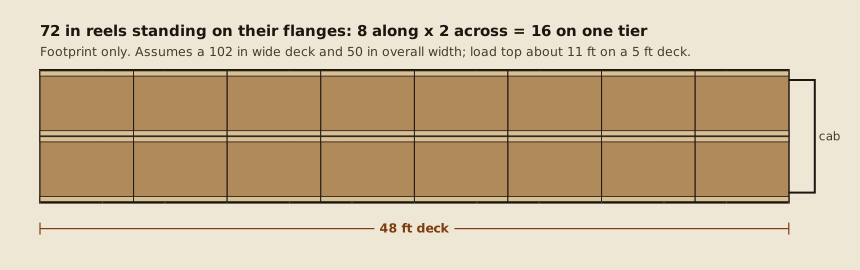
The narrow builds, about 41.5 to 44 in wide overall, fit two across a 102 in deck and eight along a 48 ft deck: about 16 in a tier. The wide builds, at 54 in and more, fit only one across, which halves the count. A standing 72 in reel on a 5 ft deck makes a load about 11 ft tall. Weight starts to matter here: sixteen heavy builds come to nearly 9,500 lb.
Second lives
Ranchers buy 72 in reels for poly pipe and heavy wire. Wire rope users store crane rope on them. Restaurants, wineries and landscapers use them as big outdoor tables or features; on its side, a 72 in reel stands about 42 to 56 in tall, depending on the build, so it's a standing-height table or a base for something else. They're also rebuilt as garden features and play structures, where their strength matters more than their looks.
Repair is worth it
A 6 ft reel is expensive to build new, so damage that would retire a small reel is often repaired on a 72 in one. A replaced flange board, a new stave or tightened tie rods put it back into service. We sort 72 in reels into ready to work, repairable and recycling only, and quote each group separately.
What to send when selling 72 in reels
For each reel, or each group of identical reels: the traverse, measured inside between the flanges; the drum diameter if you can see it, or the overall width; any stencils showing the maker or a return notice; and a photo of each flange face and of the arbor hole. Utility reels sometimes carry a reel number and an owner's name, which tells us at once whether the reel should go back. Three or four clear photos let us quote accurately without a site visit.
Keeping them sound on site
Reels this size often wait weeks for collection. Keep them on their flanges on a gravel pad or timbers, not on clay that turns to mud after rain. Rows should run in the same direction so the forks can reach each one. Pull loose lagging away from the base, where it holds water against the flange rims.
Questions
How much does a 6 ft cable reel weigh?
Between 335 and 592 lb empty for the Okonite builds.
How tall is a 72 in reel on a truck?
On a standard 5 ft flatbed deck, the top of the reel is about 11 ft off the road.
Are 72 in reels returnable?
Some utility reels are, especially with a deposit. Check the stencils before selling.