Delivery
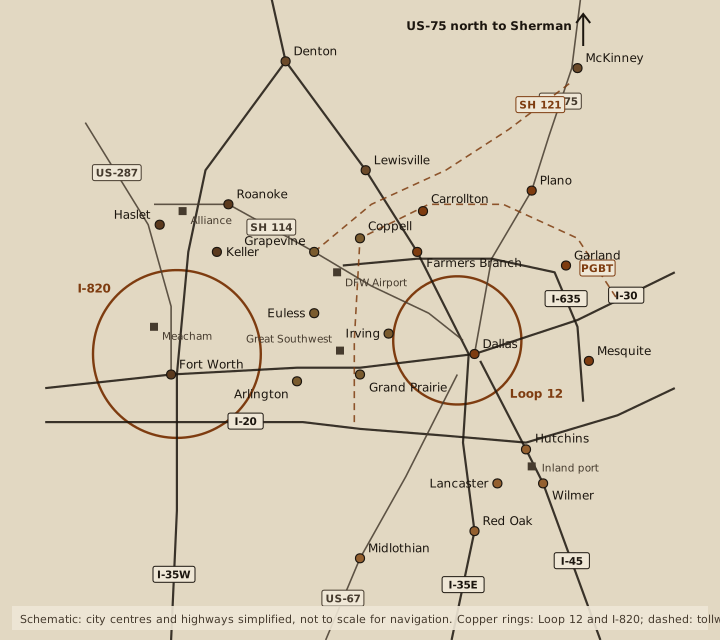
We deliver on flatbeds across the five areas we cover: the Dallas side, the Fort Worth side, the Mid-Cities, the north corridor to McKinney, Denton and Sherman, and the south Metroplex down to Midlothian and Red Oak. Trucks run routes by area, so a delivery to Plano might go out with pickups in Carrollton and Garland. Tell us the delivery ZIP and when you need the reels; we'll give a date and a delivery cost with the quote.
What we need at your end
| Reel size | How it usually comes off the truck | What you need on site |
|---|---|---|
| Up to 36 in | By hand | Two people and somewhere to stand the reels |
| 42 to 48 in | By hand with a ramp, or a forklift | A ramp or a forklift, and level ground |
| 60 to 72 in | Forklift or telehandler | A machine with long enough forks, or tell us there isn't one |
| 84 in and up | Forklift or telehandler; sometimes a winch | Firm, level ground and space for the truck alongside |
| Bulk stacks | Forklift, pallet by pallet or reel by reel | A forklift and a clear area for the stack |
If there's no machine on site, say so. We'll plan the unloading, or suggest a smaller reel that's easier to handle. Big reels should never be rolled off a truck bed without control.
Collection
If you'd rather collect, we'll have the reels ready at an agreed time and place in the Metroplex, which we confirm when the order is set. Bring a vehicle sized for the reel: a pickup takes reels up to about 36 in, a car trailer takes up to about 48 in, and anything bigger needs a flatbed or a gooseneck. Bring straps, too: a reel that isn't strapped down can roll forward under braking, or slide off a trailer on a turn.
Strapping a reel for the road
- Stand reels on their flanges, not on their sides, with the flanges facing front and back.
- Chock each reel front and back so it can't roll.
- Use at least two straps over each reel, through the arbor hole or over the drum, not just across the top of the flanges.
- Check the straps after the first few miles; wood settles.
Delivery to a business or a home
Business deliveries usually go to a dock, a yard or a site gate, during working hours. Home deliveries go to a driveway or a spot the truck can reach safely; drivers won't drive onto lawns, soft ground or over kerbs that could crack. If the reel's going into a back garden, plan how it will get there from the driveway: a 48 in reel can be rolled with care on hard ground by two people, but not over steps.
Timing and weather
Deliveries run in daylight on working days, and most are booked a few days ahead. Texas weather occasionally gets in the way. Heavy rain turns unpaved ranch tracks and new-build lots into mud that a loaded flatbed can't cross, and strong winds make tall stacks risky to unload. If the forecast looks bad, we'll call or email before setting off and agree a new date rather than risk getting stuck or damaging your ground. Summer heat doesn't stop deliveries, though early starts are common from June through September.
What it costs
The delivery charge depends on distance, the size of the order and whether the truck is already heading your way. A single spool delivered to a ZIP code our trucks visit regularly costs less than one sent alone to the edge of the area. Bulk orders spread the cost across many reels. The quote always shows delivery as its own line, so you can compare it with collecting.
Questions
Can I collect the same day?
Sometimes, if the reel is ready. Ask before you set off so we can confirm the reel and the time.
Do drivers help carry reels into a building?
Drivers unload at the truck. Moving reels inside a building is up to you.
Can delivery be combined with a pickup?
Yes. If you're buying some reels and clearing others, one truck can do both.
Request a pickup or a quote
Count and flange size are the two things that matter. The rest helps us plan the truck.