Cable reel size chart: flange, traverse and drum for common wooden reels from 24 to 96 inches, with weights and what each is used for.
Reel types explained for DFW buyers and sellers: nailed wood, plywood, wooden drums, plastic, steel and compartmental reels.
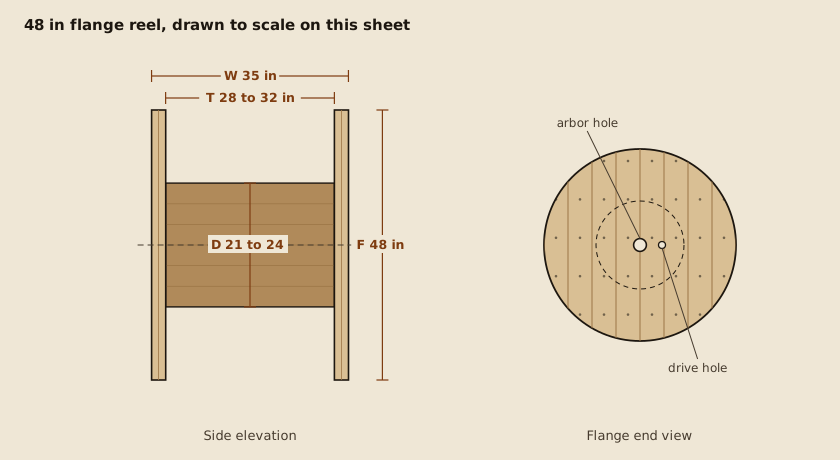
The parts of a reel
Every cable reel, whatever it's made of, has the same parts. Learning their names makes it much easier to describe what you've got.
- Flanges. The two round ends. Their outside diameter is the size people quote: a "48 in reel" has 48 in flanges.
- Drum. The core the cable is wound on. On a nailed reel it's made of staves, narrow boards nailed around the edge of the flanges' inner circles.
- Traverse. The width between the inside faces of the flanges, which is the space the cable actually fills.
- Arbor hole. The hole through the middle of both flanges, often lined with a steel plate on bigger reels, where a bar or spindle passes through so the reel can turn.
- Drive hole. A smaller hole off-centre in the flange, used by payoff and take-up machines to turn the reel.
- Lagging. Boards nailed across the outside of the flanges to protect a full reel of cable; usually removed before the cable is used.
How reels are built
| Build | Typical sizes | Where you'll see it |
|---|---|---|
| Nailed wood | 24 to 96 in and more | Building wire, feeders, utility and medium-voltage cable |
| Plywood with bolts | 12 to 36 in, sometimes larger | Building wire, data, control and low-voltage cable |
| Wooden drum, heavy build | 84 in and up | Large power cable and conductor |
| Plastic | Under 12 in to about 36 in | Small-gauge wire, fiber, welding wire |
| Steel | 30 in and up | Returnable reels for heavy cable and wire rope |
| Compartmental | Varies | Several cables on one reel, in separate sections |
Each build has its own page under reel types.
Sizes and what they mean
Flange diameter is the first thing anyone asks about a reel, because it decides almost everything else. Small reels, up to about 36 in, can be moved by hand and stacked. Mid-size reels, 42 to 60 in, need a ramp or a forklift and take up serious deck space. Large reels, 72 in and up, are machine-only and carry the heaviest cable. The reel sizes pages give dimensions and weights for each common size, taken from the Okonite reel tables, along with how many fit on a flatbed.
Why the yard is sorted this way
Buyers ask for a size and a build: "twenty 36 in nailed reels" or "one 72 in reel for a table." Sellers describe their stack the same way. Sorting the yard by build and flange size means a request can be matched quickly, and it keeps reels for cable work apart from reels for tables, ranches and recycling.
What a reel's markings tell you
Most reels carry stencils or stamped plates. The maker's name and a reel number are common; so are the reel maker's own mark, a size code and a date. "Returnable", "property of" or a deposit notice means the reel belongs to someone and should go back. "Non-returnable" or "one-way" means it's yours to sell, reuse or recycle. Arrows show which way to roll a full reel so the cable doesn't loosen. A weight stencil, where present, usually gives the gross weight of the full reel, not the empty one. Photos of these markings help us answer questions about a reel faster than any description.
Reel stands, jacks and trailers
Whatever the build, a reel only does its job if it turns. Small reels sit on a simple stand or a bar between two sawhorses. Mid-size reels go on screw jacks or a reel stand with a spindle through the arbor. Big drums go on hydraulic jacks or a reel trailer. When you buy a reel to wind or pay off cable, check that its arbor hole suits the spindle you've got.
Questions
Are reels and spools the same thing?
Yes, in practice. "Spool" is more common for small reels and in everyday speech; "reel" or "drum" is the trade term for larger ones.
How do I find the size of a reel?
Measure straight across one flange, through the arbor hole, from rim to rim. Our measuring guide explains the other dimensions.
Which reels are worth the most?
Sound nailed reels in sizes contractors use regularly. See what empty reels are worth.
Request a pickup or a quote
Count and flange size are the two things that matter. The rest helps us plan the truck.