Why most reels are nailed
Lumber and nails are cheap, strong and easy to work with. A nailed reel can be built in almost any size, from a small reel for service cable to a drum taller than a person, and the same machines and crews build them all. Board flanges cope with outdoor storage far better than plywood, and a damaged board can be replaced. North Texas builds them in quantity: Madem-Moorecraft's Denton plant added a second nailed-reel line in February 2025, and Lone Star Reel builds reels in McKinney and Bonham.
Strengths and weak points
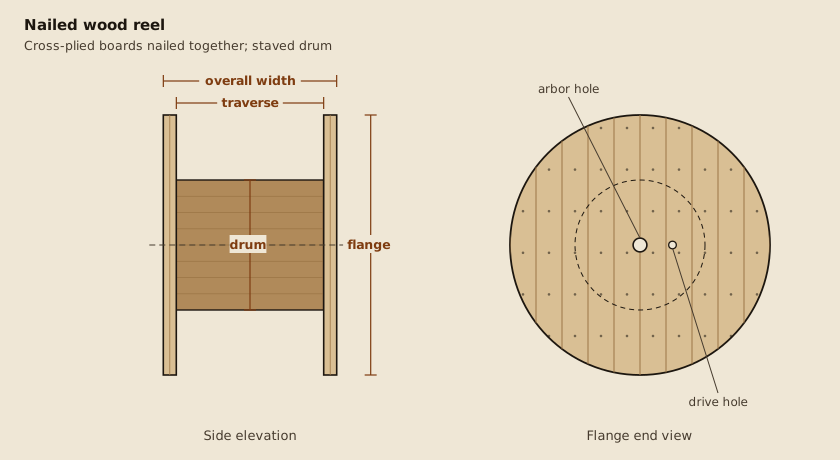
Nailed reels are tough, but they fail in predictable ways. Nails work loose as the wood dries in summer and swells after rain. Staves split along the grain if a full reel is dropped or a cable is pulled hard off the top. Flange boards crack where a forklift tine has gone through them. And the arbor hole wears oval when a reel is spun on a loose bar. None of this is visible from twenty feet away, which is why every reel gets a close look before it's sold for cable work.
Returnable, refurbishable, or one-way
Some nailed reels are built to go back. Sonoco describes its nailed reel flanges as returnable and refurbishable, and wire makers such as Service Wire run return programs for their own nailed reels within set sizes and conditions. Many more nailed reels are one-way: stencilled non-returnable, or simply not wanted back. A one-way nailed reel that's still sound is the most useful thing in a reel yard, because there's always someone who needs one.
Repairs we see
- A loose or split stave can be renailed or replaced if the flanges are sound.
- A cracked flange board can be replaced on larger reels, where the reel is worth the work.
- Popped nails can be driven back or replaced with fresh ones.
- A worn arbor hole can sometimes be plated; if it's torn, the reel is usually done for cable work.
Small nailed reels rarely justify repair; big ones often do. A 72 in reel with one bad board is worth fixing. A 24 in reel with the same damage is better recycled.
End of life
When a nailed reel can't be reused or repaired, it's taken apart. The nails come out with magnets, and the boards go on to grinding for mulch, bedding or fuel, or are reused as repair stock. Nailed reels are the easiest reels to recycle cleanly, because there's no glue and very little metal beyond the nails. Our page on wood reel recycling in North Texas explains where the wood goes.
Buying a nailed reel
Tell us the flange size, the traverse if it matters, and what the reel's for. For cable work, we'll send one that passes our checks; for tables and ranch use, a weathered reel may suit and costs less. See used cable reels or large wooden spools.
Storing nailed reels well
Stand them on their flanges, in rows, on gravel, concrete or dunnage. Lying flat traps water on the upper flange and pushes the lower one into the ground. Leave space between rows so a forklift can reach each reel.
Southern yellow pine and other softwoods are typical reel lumber; hardwood turns up in some heavy builds and older drums.
Questions
How long does a nailed reel last?
Years, if stored sensibly: on its flanges, off bare soil, out of standing water. Reels left lying in mud can rot in a season.
Can I take a nailed reel apart myself?
Yes, with a pry bar and care. Wear gloves and eye protection; the nails are long and often bent.
Why are some nailed reels painted?
Paint protects the wood and marks the owner. Painted reels are often returnable; check the stencils.