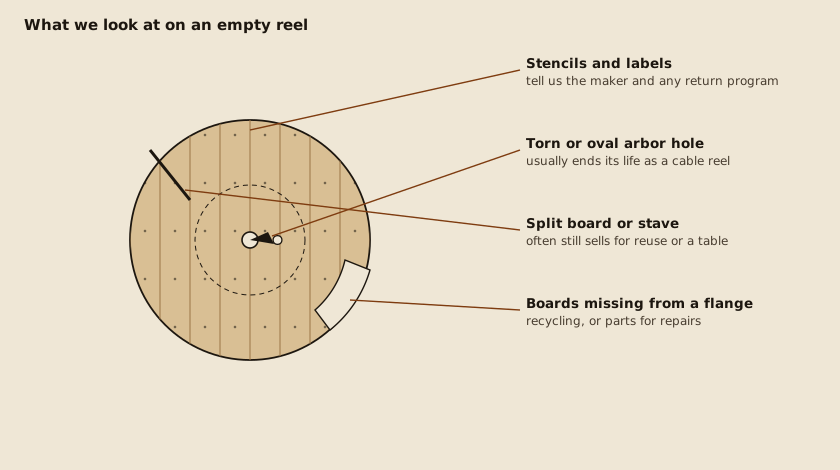
The checks, in order
- Arbor hole. Is it round, and are the edges clean? An oval or torn hole means the reel wobbles on a shaft. That's the first thing a cable buyer checks.
- Drum staves. Are they all there, tight and unsplit? A missing or crushed stave leaves a gap that snags cable. Service Wire's published return terms set a bar of at least 75% of the stave boards intact, which is a useful rule of thumb.
- Flanges. Are they flat and square to the drum? Look for boards split right across, layers separating, or a flange that rocks when you push it.
- Fasteners. Are nails proud, rusted through or missing? Are bolts loose, bent or gone? Proud nails are a hazard to hands and cable alike.
- Rot and soak. Push a screwdriver into the wood at the bottom edge, where a reel sits in water. If it sinks in easily, the wood is soft.
- Contamination. Oil, paint, tar, chemicals or concrete splashes limit where a reel can go, including recycling.
Grading what you find
| Grade | What it looks like | Where it goes |
|---|---|---|
| Sound | Round arbor hole, tight staves, flat flanges | Back into service carrying cable or rope |
| Worn | Weathered, a cracked flange board, a loose nail or two | Tables, ranch use, storage, light rewinding |
| Broken | Missing staves, split or loose flanges, torn arbor hole | Wood recycling |
| Contaminated | Soaked in oil, coated in concrete, chemically treated | Specialist disposal; ask first |
What weather does to reels
Dallas-Fort Worth is hard on wooden reels. Summer heat dries the wood and shrinks it away from the nails. Spring storms soak the bottom edges of reels standing in a laydown yard, and the ground stays wet under them. A reel left on bare dirt for one season can go from sound to worn; two seasons and the bottom staves start to soften. Standing reels on dunnage or pallets, off the ground, buys a lot of time.
Damage from handling
Forklift tines are the commonest cause of broken flanges. Driving tines into the drum instead of under the reel crushes staves. Dropping a reel from a truck bed cracks flange boards along the grain. Rolling a reel off a ramp and letting it fall on its side can split both flanges at once. Our guide to moving large spools covers safer ways to shift them.
Unusable doesn't mean worthless to clear
Even a pile of broken reels costs money to keep. It takes yard space, collects water and pests, and is a trip hazard. Clearing broken reels with the sound ones in a single pickup is usually cheaper than paying for a dumpster. Our damaged reels page explains how we handle them, and what empty reels are worth covers how condition affects the offer.
Pests
Wooden reels left on the ground for long periods can attract termites and carpenter ants, and North Texas has plenty of both. Look for mud tubes on the lower staves, small piles of frass under the flanges, or wood that sounds hollow when tapped. An infested reel shouldn't go near a building or a timber structure, whatever its other condition, and it should be recycled promptly rather than reused.
A second opinion
If you're unsure, take two photos, one of each flange face, and one of the drum through the traverse. Send them when you book a pickup. Sorting reels is our daily work, and a quick look at a photo usually tells us whether a reel is sound, worn or broken, and what that means for your load.
Fire and smoke damage
Reels scorched in a yard fire or stored near one may look fine but have charred, weakened wood under the surface. Treat them as broken.
Nails and splinters
Even a structurally sound reel can be unpleasant to handle when nails stand proud and the flange edges have splintered. That doesn't make it unusable, but it lowers its grade and means it needs work before resale.
Questions
Is a cracked flange board the end of a reel?
Not necessarily. One cracked board on an otherwise sound flange is usually a worn reel, not a broken one.
Can you repair broken reels?
Some nailed reels can be repaired by a reel refurbisher. We sort them; we don't promise repairs.
Will you take reels covered in concrete?
Ask first, with photos. It depends how much and where.