Why reels build up on site
Feeder, branch and low-voltage cable all arrive on reels, and on a large project a single pull can empty a dozen of them. The cable is the scheduled item; the empty reel isn't. It gets rolled to the fence, then the next one goes beside it, and three months later the laydown yard is half reels. On the data-centre campuses going up around the Metroplex, where CBRE counted 425.1 MW of capacity under construction in the first half of 2025, that pattern repeats on site after site.
What we take off a jobsite
- Nailed wood reels of any brand, 24 in up to 96 in and larger drums
- Plywood reels from low-voltage, control and data cable
- Plastic reels and spools from small-gauge wire
- Steel reels, which we sort for return or scrap rather than wood recycling
- Broken reels, loose flanges and split lagging, picked up with the rest
Cable still on a reel isn't ours to take. If a reel has usable wire left on it, the contractor or the owner decides what happens to it first.
Working around the job
General contractors and electrical subs care about two things: the truck mustn't block a pour, a crane pick or a delivery, and nobody should have to stop work to load reels. Tell us the site's gate hours, its badge or escort rules and any no-go times, and we fit the pickup to them. If the yard has a forklift and an operator, loading is quick; if not, say so and we plan the truck around it. Many sites prefer two or three visits across the electrical phase to one big clear-out at the end, because the space is worth more than the time it takes to schedule.
Before the truck comes
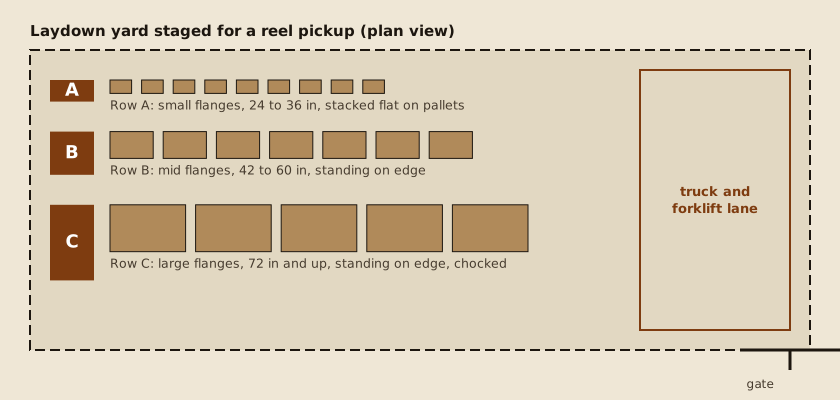
- Group reels by flange size where you can, small with small and large with large.
- Keep a straight lane from the gate to the stack, wide enough for a flatbed.
- Stand big reels on their flanges, not on their sides; they load faster and don't trap water.
- Pull out anything that isn't a reel. Pallets, cable cut-offs and packing go in the site's own waste.
Our guide to staging reels for pickup covers each step in more detail, with the reasons behind them.
Sorting on site, or not
Some superintendents like the reels sorted before we arrive; others have no crew to spare. Either is fine. Sorting by flange size saves loading time, and splitting obviously broken reels from sound ones makes the quote firmer, but we can do both at the truck if needed. What slows a pickup down is a stack buried under conduit bundles, scrap copper bins and pallets, or one jammed against a fence line where a forklift can't reach. A cleared perimeter and a gate that opens wide matter more than tidy rows.
Weather and the reels' value
North Texas weather is hard on idle reels. Summer heat dries the staves and loosens nails; heavy spring rain soaks plywood flanges and starts them peeling apart in layers. A reel taken off site within a few weeks of being emptied is far more likely to be reused than one that has stood through a season. That's the practical case for regular visits during the job instead of a single sweep at the end: more of the reels keep their worth, and the yard stays usable for materials that are still to come.
Closeout and records
If your project needs a record of where reels went, for a waste diversion credit or simply the owner's closeout binder, ask when you book. We can confirm in writing what was picked up and when, by count and size, and say which reels went on for reuse and which went to wood recycling. We don't issue certificates we can't stand behind, and we won't claim a diversion figure we haven't measured.
Questions
Can you pick up before the job is finished?
Yes, and it's usually better. Clearing reels during the job frees space for the next phase and keeps the empties from weathering.
Do you need a badge or site induction?
Tell us the site's requirements when you book and we plan for them. Some sites send their own escort to the gate.
What if some reels still have cable on them?
We leave those for the contractor to sort. We only take empty reels, or reels you tell us in writing are scrap.
Request a pickup or a quote
Count and flange size are the two things that matter. The rest helps us plan the truck.