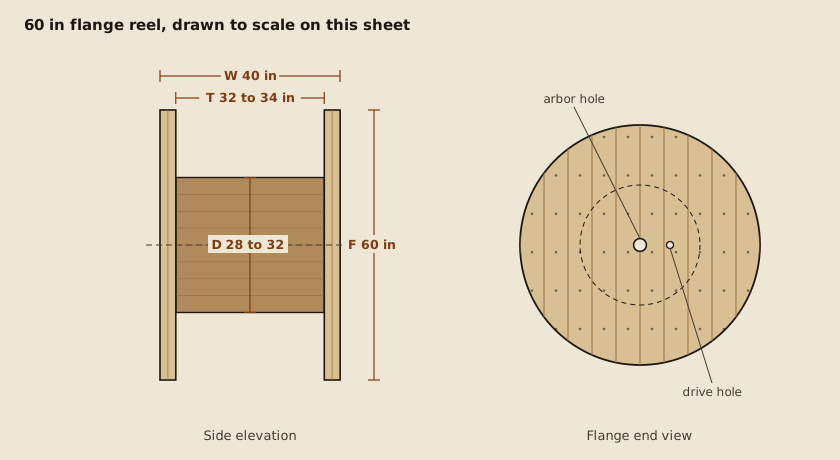
There's no exact 60 in row in the Okonite table. Real 60 in reels fall between the 58 and 62 in rows, so expect roughly 190 to 350 lb empty, depending on the build.
The drum gets bigger
At this size the drum is 28 in or more across. That isn't just about strength: power cable has a minimum bending radius, and bigger, stiffer cable needs a bigger drum so it isn't damaged by being wound too tightly. A 60 in reel with a 30 in drum suits cable that a 48 in reel with a 22 in drum couldn't safely carry. If you're buying a 60 in reel for cable, give us the cable's minimum bending radius or its outside diameter.
Where they come from in DFW
Utility and co-op distribution work, substation jobs, large commercial feeders, data-centre service entrances, industrial plants, and wire rope suppliers. Oncor's 2025 to 2029 capital plan and the steady data-centre construction across the Metroplex both mean a steady stream of reels at this size.
Machine only
Don't move 60 in reels by hand except to nudge one a few inches on level ground. Use a forklift with forks long enough to reach under both flanges, a telehandler, a tractor with forks, or a winch. Stand them on firm, level ground on their flanges, and chock them both sides. Our guide to moving large spools has more.
On the truck
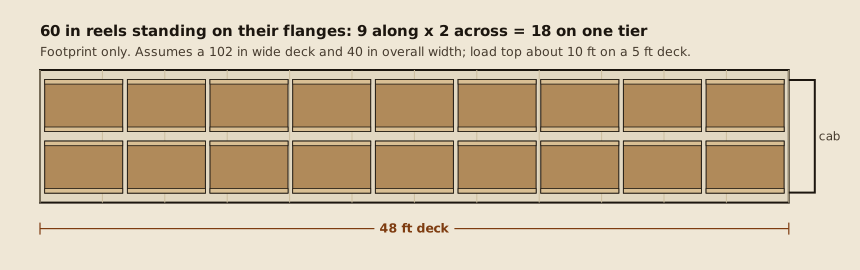
A 60 in reel with an overall width of about 40 in fits two across a 102 in deck and nine along a 48 ft deck: about 18 in a tier. Standing on a 5 ft deck, the load is about 10 ft tall. A tier of 18 weighs 3,400 to 6,300 lb, depending on the build.
Ranch, rope and outdoor use
Sixty-inch reels are a ranch favourite: big enough for a full roll of poly pipe or a long stretch of high-tensile wire, heavy enough to stay put when wire is pulled off them. Rope users store long lengths of synthetic and wire rope on them. Landscapers and venues use them as big outdoor tables, where they stand about 37 to 41 in tall on their sides: bar height.
Selling them
Sound 60 in reels are valuable, and a few of them in a load make a big difference to the quote. Mention them separately and photograph each one if you can, including the arbor hole.
Inspecting a 60 in reel
Big reels hide damage in places you can't see from the yard. Walk round the reel and look at both flange faces for cracked or sprung boards, especially near the rim where forklift tines hit. Look through the arbor hole: the steel plates on each side should be tight and the hole round. Check the tie rods, if fitted, for loose nuts. Tap the lower staves with a hammer; a dull, soft sound means rot, common on reels that stood in wet ground. Any of those problems turns a cable reel into a ranch or recycling reel, so it's worth knowing before you quote a price or pay one.
Weathering at this size
Sixty-inch reels usually spend long periods outside, on utility yards and laydown areas, and they weather from the bottom up. The lower flange rim sits in whatever the ground holds, mud after a spring storm, dust and heat in August, and the boards there split and soften first. Turning reels a quarter turn every few months, or standing them on timbers, adds years to their life.
Questions
How much does a 5 ft cable reel weigh?
Roughly 190 to 350 lb empty, from the 58 and 62 in Okonite rows either side of it.
Can a 60 in reel go on a car trailer?
Only a heavy-duty one, and only if it can be loaded by machine and strapped properly. A flatbed is better.
How tall is a 60 in reel on its side?
About 37 to 41 in, depending on the traverse: around bar height.