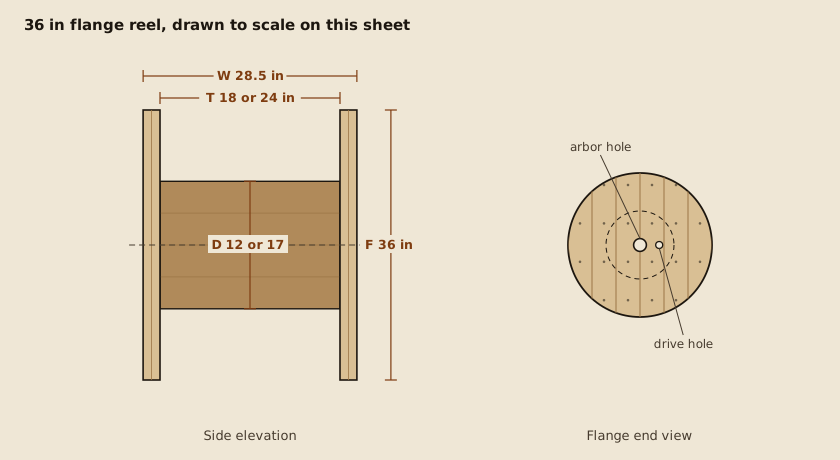
The flange
The flanges are the two round ends. They hold the cable on, carry the reel's weight when it stands, and let it roll. On a nailed wooden reel each flange is two or three layers of boards, cross-laid and nailed. On a plywood reel it's a sheet of plywood. The flange diameter is the number a reel is known by, so a 60 in reel has flanges about 60 in across.
What it decides: how much cable the reel can hold in total, how tall it stands, how many fit across a truck deck, and whether it fits through a doorway.
The traverse
The traverse is the inside width between the flanges, the lane the cable is wound into. A wider traverse holds more cable at the same flange size, but needs a wider truck slot and a wider stand.
What it decides: how much cable fits per layer, whether a coil of rope or hose will drop in, and the reel's overall width once you add the flanges.
The drum
The drum, also called the barrel or core, is the cylinder the cable wraps around. On wooden reels it's built from staves, narrow boards running between the flanges. Its diameter matters because cable can only bend so tightly before it's damaged. Every cable has a minimum bending radius, and the drum must be at least that big.
What it decides: which cables the reel can safely carry. Stiff, heavy cable needs a bigger drum, which is one reason big reels have drums 36 to 56 in across.
The arbor hole and drive holes
The arbor hole is the hole through the middle of each flange. A shaft or spindle goes through it so the reel can turn on a stand or a trailer. Drive holes are smaller holes off-centre that a payoff machine uses to turn the reel. Service Wire's published reel return terms ask for undamaged arbor and drive holes, which shows how much they matter: a torn arbor hole stops a reel turning true.
How they fit together
| Reel (F × T × D) | Overall width | Empty weight | Rated cable load |
|---|---|---|---|
| 24 × 12 × 10 in | 15 in | 23 lb | 350 lb |
| 36 × 24 × 17 in | 28.5 in | 77 lb | 2,000 lb |
| 50 × 32 × 24 in | not listed | 143 or 177 lb | 3,000 or 4,800 lb |
| 72 × 36 × 36 in | not listed | 335 or 559 lb | 4,500 or 8,000 lb |
| 96 × 48 × 48 in | 55.5 or 56.5 in | 758 or 1,078 lb | 6,000 or 15,000 lb |
Okonite Company, Technical News Edition 33, "Reel Anatomy", November 2016; Service Wire, Reel Return.
Where Okonite lists two weights for the same dimensions, the heavier reel is a stronger build with a higher rated load.
Which part fails first
On wooden reels in Texas weather, the drum staves usually go first. They're thinner than the flange boards and they take the cable's crushing load. Next come the flange edges, chipped by forklift tines and dropped loads. Arbor holes tear when a reel is turned on a shaft that's too small or dragged off a stand. Our guide to what makes a reel unusable goes through the signs.
Freeboard
Freeboard is the gap between the outermost layer of cable and the rim of the flange. Cable makers leave a few inches of it so the flanges, not the cable, take the knocks during handling and so the reel can roll without crushing the outer turns. When you're judging whether a reel can carry a given cable or rope, work out the wound diameter and check that it leaves freeboard below the rim. A reel filled to the flange edge is a reel waiting to damage its load.
Why the parts wear differently
The flange faces see weather on both sides and the occasional forklift tine, so they weather first but usually stay strong. The staves sit inside, carry the cable's weight and squeeze, and suffer most when a reel stands on wet ground. The arbor hole sees wear only when the reel turns on a shaft. So a reel that's spent a year standing in a laydown yard often has a weathered but sound flange, damp lower staves, and a perfect arbor hole.
Matching parts to the job
For winding heavy power cable, the drum and the rated load matter most. For storing rope or hose, the traverse and flange decide capacity. For a table, it's flange diameter and overall width. So the "best" reel depends entirely on what comes next.
Terms you'll also hear
Builders and cable crews use other words for the same parts. The drum is also the barrel, hub or core. The traverse is sometimes called the inside width or the winding width. Flanges are occasionally called heads or ends. The arbor hole is also the spindle hole or centre bore. Whatever word you use, we'll know which part you mean.
Questions
Is traverse the same as width?
No. Traverse is the inside gap; overall width includes both flanges.
Why does drum size matter for an empty reel?
It decides which cable the reel can carry next, which decides who'll want it.
Which number do I give when booking a pickup?
The flange diameter and a count. That's enough to plan a truck.