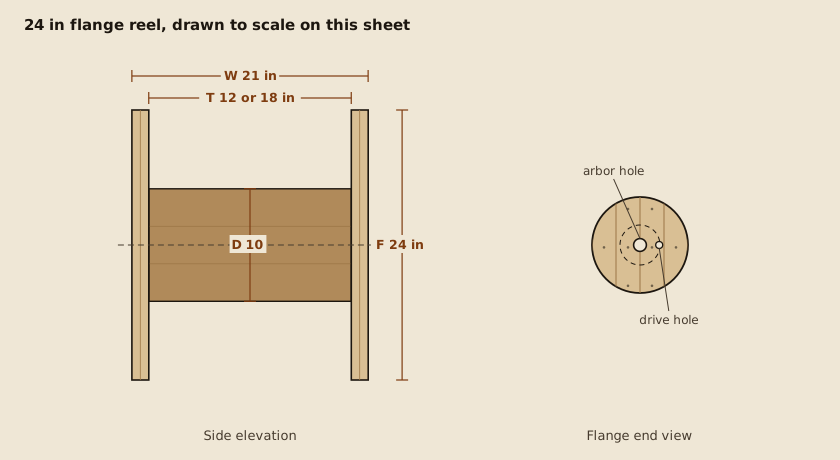
The rows read flange × inside traverse × drum. Both 24 in reels are rated for 350 lb of cable; the wider one just holds a smaller-diameter cable in more turns.
What comes on a 24 in reel
Short runs of building wire, the last few hundred feet of a cut-to-length order, service-entrance and small control cable, low-voltage cable for security and audio-visual work, and some fiber. Distributors who sell wire by the foot use them as take-up reels on the counter. Many 24 in reels are plywood with bolts; small nailed reels and plastic reels are common too.
Handling
At 23 to 24 lb empty, one person can carry a 24 in reel, and a pickup bed takes a stack of them. Stood on their flanges they roll easily, which is handy on concrete and a nuisance on a slope. They stack flange on flange better than larger reels, three or four high if they're dry and sound, which makes them easy to store in a corner until there are enough to collect.
How many fit on a truck
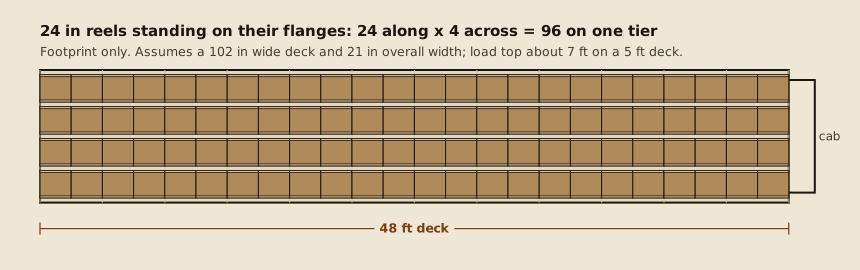
On a 48 ft flatbed with a 102 in deck, 24 in reels standing on their flanges go four across and twenty-four along, about 96 in one tier. Because they're light, small reels are often stacked a second tier high and strapped, roughly doubling that. Most loads of 24 in reels go on a box truck or a smaller flatbed instead, since the numbers rarely fill a full deck.
Who wants them
- Supply counters and electrical shops rewinding cut lengths for customers
- Gardeners and nurseries for hose, drip line and twine
- Makers and market sellers for side tables, plant stands and displays
- Workshops storing extension cords, air hose and welding leads
- Event planners who need light, matching pieces they can move by hand
Selling 24 in reels
Single small reels aren't worth a truck trip on their own, but they add up. A branch that empties a few a week, or a data-cable job that leaves fifty identical ones, has a load worth collecting. Keep them dry, especially plywood ones, and stack them by build. Count them when you ask for a pickup, and say whether they're plywood, nailed or plastic. Sound plywood reels in matched batches are the easiest to sell on.
As a table
A 24 in reel makes a side table, a plant stand or a stool, not a dining table. On its side it stands about as tall as its overall width, 15 to 21 in, which is low-coffee-table height. Sand the top flange, fill the arbor hole or use it for a lamp cable, and seal it if it'll live outdoors. Our spool table guide covers the steps.
Checking a small reel
Small reels get thrown around more than big ones, so check them properly before reusing one for cable. Spin it on a bar: it should turn without a wobble. Look at the flange where it meets the drum; hairline cracks there spread fast under load. On plywood reels, press a thumbnail into the flange edge. If it sinks in or the layers lift, the reel has taken on water. On nailed ones, look for staves that have shifted, leaving a gap you can slide a coin into. And make sure the arbor hole is clear of splinters and old tape, which jam a spindle.
Why matched batches matter
A single 24 in reel has many possible uses; fifty identical ones have a market. Shops that rewind wire, makers producing furniture in runs, and event companies all prefer matched sets, because the reels stack, display and price the same. If a job leaves a batch from one maker, keep it together.
Questions
How much does an empty 24 in reel weigh?
About 23 to 24 lb for the nailed reels in the Okonite tables. Plywood reels of this size are often a little lighter.
Will a 24 in reel fit in a car?
In many hatchbacks and SUVs with the seats folded, yes. Measure the opening first.
Is a 24 in reel worth selling?
In batches, yes. On its own, it's better collected alongside larger reels.