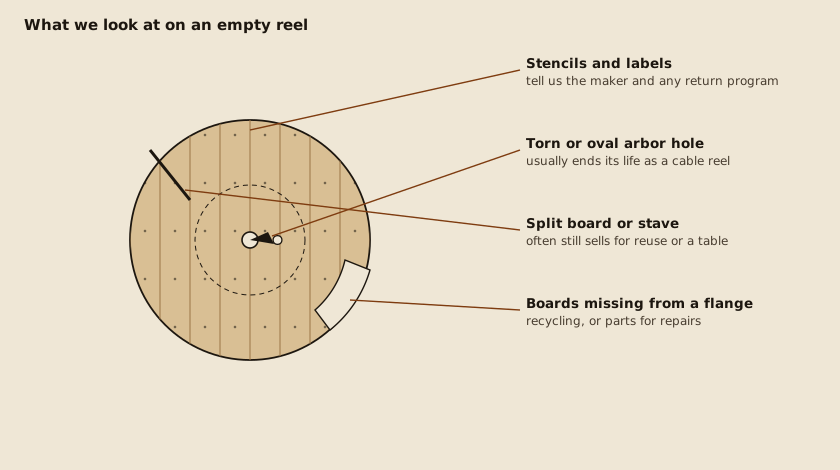
The damage we see most
| Damage | Usually caused by | What happens to the reel |
|---|---|---|
| Flange split across the grain | Dropping a loaded reel, forklift tines through the flange | Recycling, unless it's one board on a nailed flange |
| Arbor hole worn oval or torn | A pay-off stand or jack spinning the reel unevenly | Recycling; a reel that wobbles on its arbor isn't safe to load |
| Plywood peeling into layers | Rain soaking the flange edges over months | Recycling once the layers separate |
| Drum staves cracked or missing | Cable pulled hard off the top, or reels stood on uneven ground | Repair on big reels if the frame is sound; otherwise recycling |
| Loose or missing lagging | Removed to reach the cable, then lost | Doesn't matter much; we don't need the lagging for reuse |
| Nail heads rusted through | Months standing in wet ground | Recycling if the flanges have pulled away from the drum |
Why broken reels aren't free to move
A damaged reel takes the same space on a truck as a sound one and costs the same to load. Where a load mixes good and broken reels, the good ones carry the cost of moving the rest, and clearing the whole stack is often free. A load that's only broken reels doesn't have that cushion, so we quote it separately, and we tell you before the truck comes.
Safety with damaged reels
Broken reels behave badly. A flange with a crack through it can fold when the reel is rolled, and a reel with a torn arbor hole can drop off a spindle. Don't roll damaged reels by hand over any distance, and don't stack them. If one has partly collapsed, leave it lying flat. Loose nails and splinters are the commonest injury; gloves and boots, nothing exotic, but don't skip them.
What happens after pickup
Damaged reels are taken apart rather than crushed whole, which keeps the wood clean enough for most outlets. Metal fixings come out on magnets, sound boards can go to repair stock for other reels, and the rest is ground. If your project needs to know where its reels went, ask and we'll confirm in writing what was taken and that it went to wood recycling.
Telling damaged from worn
Plenty of reels look rough without being unusable. Faded stencils, dirt, scuffed flange edges and missing lagging boards don't stop a reel being reused. The tests that matter are simple: do the flanges sit square to the drum, is the arbor hole round, and do the drum staves sit tight? A reel that passes those is worth more than its looks suggest. Our guide on what makes a reel unusable shows how to check.
Repair is sometimes the answer
Big reels are worth fixing. A 72 in or 84 in nailed reel with one cracked flange board and a sound drum can be relagged and renailed, and goes back to work carrying medium-voltage cable or rope. The arithmetic changes with size: replacing a board on a 30 in plywood reel costs more in time than the reel is worth, while the same repair on a drum saves a reel that would cost a lot to build new. That's one reason we ask for photos up front, because whether a reel counts as damaged or repairable depends on what it is.
Termite or beetle damage is rarer but real on reels that sat in contact with soil for years; powdery, hollow-sounding wood means recycling.
Questions
Should I break up damaged reels before pickup?
No. Whole reels are easier and safer to load, and breaking them up yourself means splinters and loose nails all over the yard.
Will you take a single broken reel?
Usually only as part of a larger pickup, or if one is already planned nearby. Send a request and we'll tell you.
Can damaged reels be burnt?
Texas restricts outdoor burning, especially in the Dallas-Fort Worth counties, and painted or treated flanges give off fumes. Check with your city before even considering it; recycling is the better route.
Request a pickup or a quote
Count and flange size are the two things that matter. The rest helps us plan the truck.