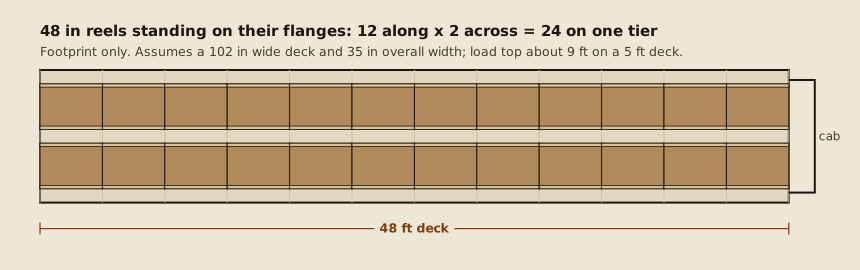
The counts by size
| Flange | Across the 102 in deck | Reels on one tier | Notes |
|---|---|---|---|
| 24 in | 4 | about 96 | Light; often loaded by hand |
| 30 in | 4 | about 76 | |
| 36 in | 3 (wide build) or 4 (narrow build) | about 48 to 64 | Depends on overall width |
| 42 in | 3 | about 39 | |
| 48 in | 2 | about 24 | Two across, twelve deep |
| 60 in | 2 | about 18 | Two across, nine deep |
| 72 in | 2 | about 16 | Two across, eight deep |
| 84 in | 1 | about 6 | Wide reels, one across |
| 96 in | 1 | about 6 | One across; check height |
How the arithmetic works
Across the deck, what matters is each reel's overall width, flange face to flange face, because the reels stand side by side with arbor holes in line. A 102 in deck takes four reels about 24 in wide, three about 30 in wide, two about 45 in wide, and one wider than that. Along the deck, each reel takes up its flange diameter, plus a little for chocks. A 48 ft deck is 576 in long, so it holds about twelve 48 in reels in a line, or eight 72 in ones.
Weight isn't the limit
Even big reels are light for their size. Sixteen 72 in reels at Okonite's heavy-build weight of 559 lb come to under 9,000 lb, well within what a flatbed is built to carry. For empty reels, the deck runs out of room long before the truck runs out of payload.
Reel weights: The Okonite Company, Technical News Edition 33, "Reel Anatomy", November 2016. Deck counts are our own arithmetic for a 48 ft by 102 in deck.
Height
Reels standing on their flanges make a tall load. A flatbed deck sits at roughly 60 in, so a load of 96 in reels stands about 13 ft above the road. Legal height limits and overpass clearances constrain the biggest reels, and they sometimes need a step-deck trailer with a lower deck to stay within limits. That's part of why we ask for sizes before we send a truck.
Mixed sizes
Most real loads mix sizes. The largest reels go first, over the axles, with smaller reels filling the remaining rows. Small reels can sometimes ride on their sides in the gaps, strapped down, which adds a few to the count. A load of mixed 36 and 48 in reels from a DFW jobsite typically fills one truck somewhere between the counts for each size alone.
Why not stack them?
Standing reels on top of standing reels is unstable on a moving truck: the upper reels rest on narrow flange rims, and straps can't hold them square. Small reels can be stacked flat on pallets, banded, but large ones ride one tier high.
Your load in trucks
| You have | Roughly |
|---|---|
| 40 reels of 36 in | Under one truck |
| 60 reels of 48 in | Two to three trucks |
| 30 reels of 72 in | Two trucks |
| 12 reels of 96 in | Two trucks, possibly step-deck |
For more than a truckload, our page on big loads explains how we schedule several trucks or several visits, and reel weights has the weight per size.
Securing the load
Every row of reels is chocked fore and aft with wooden blocks nailed or clamped to the deck, so the reels can't roll when the truck brakes or accelerates. Straps run over the top of each row, or through the arbor holes, and are tightened down to the deck's rub rail. Federal cargo securement rules apply to rolling loads like reels, and drivers check straps at their first stop and periodically after. That's another reason not to overfill a deck: chocks and straps need room.
Pickups and trailers for small loads
Not every load needs a tractor-trailer. A handful of 24 to 36 in reels fits in a pickup bed or on a utility trailer. A gooseneck or hotshot trailer of 30 to 40 ft carries a useful middle load of medium reels and reaches tight sites a full flatbed can't. When you book, tell us the count and sizes, and we'll send the smallest vehicle that does the job in one trip.
Counting your own load
To estimate how many trucks you need, add up how much deck length each size takes. For each size, divide the count by the number that fit across the deck, then multiply by the flange diameter. Add the results, and divide by 576 in for a 48 ft deck. Round up. It's rough, but it'll tell you whether you need one truck or several.
Where loading happens
Side loading with a forklift is fastest: the driver drops the straps, and the forklift sets each reel in place from the deck edge. Without a forklift, small reels are hand-loaded and medium ones are ramped. Tell us which applies at your site.
Step-deck and lowboy trailers
For the tallest reels, a step-deck trailer's lower main deck brings the top of the load down by a couple of feet. A lowboy goes lower still, but carries fewer reels and is rarely needed for empties. We choose the trailer when we know the biggest flange in the load, so tell us about any 84 or 96 in reels up front.
Questions
How many 48 inch reels fit on a flatbed?
About 24, two across and twelve deep, on a 48 ft deck.
Do you use box trailers?
Flatbeds are easier to load from the side with a forklift, so we usually use them for reels.
Can a half load be combined with another site?
Sometimes, when sites are close together and timing suits. Ask.