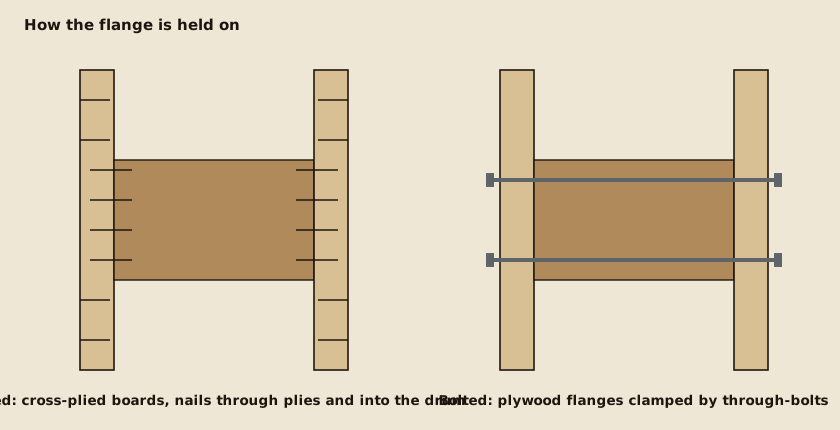
Nailed reels
Most large wooden reels are nailed. Each flange is built from two or three layers of sawn boards laid at angles to each other, then nailed through. Staves, the narrow boards that make the drum, are nailed into slots or onto blocks on the inside faces of the flanges. Sonoco, one of the big reel makers, describes its nailed wood reels as returnable and refurbishable, which says something about their strength: a nailed reel can be stripped, re-staved and sent out again.
Strengths. Heavy loads, large sizes, repairable, tolerant of rough handling. Almost every reel of 60 in and up that we see is nailed.
Weak points. Nails work loose as the wood dries and swells through a North Texas summer and a wet spring. Staves crack under crushing loads. Flange boards split along the grain when a forklift tine catches an edge.
Bolted plywood reels
Plywood reels use a single sheet of exterior plywood for each flange, often with a fibre, plywood or wooden drum. Steel bolts pass through both flanges, usually four or more spaced around the drum, and nuts on the outside clamp everything together. They're lighter than nailed reels of the same size and cheaper to make, which is why so much building wire and communication cable ships on them in 12 to 36 in sizes.
Strengths. Light, flat-faced, stackable, cheap. Good for one trip of light cable.
Weak points. Plywood delaminates when it stays wet. Bolt holes elongate and let the flanges wobble. Fibre drums soften and crush. Most plywood reels are built as one-way packaging, and few are worth repairing.
Side by side
| Nailed reels | Bolted plywood reels | |
|---|---|---|
| Typical sizes | 30 to 96 in and larger | 12 to 36 in, sometimes larger |
| Flange | Cross-laid sawn boards | One plywood sheet per flange |
| Fastening | Nails through boards and into staves | Steel through-bolts and nuts |
| Weight | Heavier for the size | Lighter for the size |
| Repair | Often repairable | Rarely worth it |
| Usual life | Several trips, if looked after | Often one trip |
| End of life | Wood recycling; nails removed by magnet after grinding | Wood recycling; bolts removed first |
How to tell them apart
Look at a flange face. Visible board edges and rows of nail heads mean a nailed reel. A smooth sheet with a ring of bolt heads or nuts around the arbor hole means a bolted plywood reel. Some heavy-duty reels use both: board flanges with tie bolts through the drum. We call those nailed for sorting, since the boards behave like any other nailed flange.
Which one buyers want
For winding cable again, buyers want nailed reels with tight staves and a sound arbor hole. For tables, workshop benches and display, plywood reels are popular because the flat face makes a cleaner top. Ranchers usually want whatever is biggest and strongest, so heavy nailed reels go there first. See our pages on nailed wood reels and plywood reels for the details of each build.
At the recycling end
Both kinds can be recycled as wood. Bolts are pulled or cut before grinding; nails go through the grinder and are pulled out of the chips by magnets. Neither kind should be burned in the open: Texas restricts outdoor burning, and treated or painted reel wood makes it worse.
Repairing a nailed reel
Refurbishers strip a nailed reel by knocking out damaged staves, replacing split flange boards and renailing the lot, often with ring-shank nails that grip better than the originals. A reel with a sound pair of flanges and a few bad staves is a good candidate. One with both flanges split across the grain usually isn't, because flange boards are the costly part.
Why bolts loosen
Plywood swells when wet and shrinks when dry. Each cycle stretches the bolt holes a little and lets the nuts back off. After a season outdoors, a plywood reel that was tight off the truck can rattle. Retightening helps only if the holes and the plywood around them are still firm.
Mixed builds in one load
A real stack seldom contains just one construction. Distributors' yards hold nailed giants from utility jobs beside plywood minis from data-cable orders, plus a few plastic spools. We sort them during loading, so there's no need to separate builds beforehand. Just give a rough count of each when you book.
Questions
Are plywood reels weaker than nailed ones?
For heavy cable, yes. For light cable on small reels, they're fine.
Can a loose bolted reel be tightened?
Sometimes, if the plywood is sound. Elongated holes and soft plywood can't be fixed.
Do you take both kinds?
Yes, together, in the same pickup.