By size
24 to 36 in, roughly 23 to 77 lb. Two people can lift these, one on each flange, knees bent, back straight. Lift onto a tailgate or into a bed, don't throw. A hand truck with a strap moves a single reel a long way with no lifting.
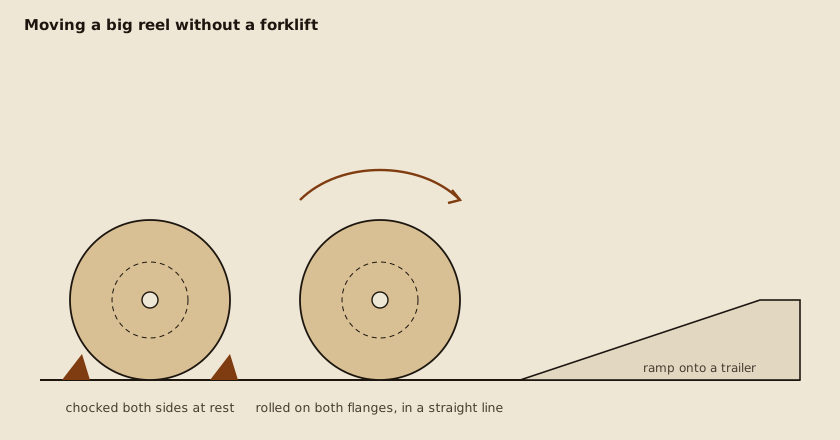
42 to 60 in, roughly 90 to 350 lb. Roll, don't lift. Stand the reel on its flanges and push from the flange rim, never from the drum. Roll on flat, firm ground. Use a ramp rated for the weight to load a trailer, with a second person at the top steadying the reel and a wheel chock ready.
72 in and up, roughly 335 lb to over half a ton. Forklift, telehandler or crane only. Check the machine's rated capacity at the load centre, because a wide reel's weight sits further out on the forks than a pallet's.
Rolling safely
- Roll in the direction the cable came off, so loose nails and splinters trail behind you.
- Keep your hands on the outer flange rim. Fingers inside the traverse get crushed.
- Never stand downhill of a rolling reel.
- Check the path first: soft ground, kerbs, cable trenches and gravel all stop a reel suddenly.
- Turn a reel by pivoting it on one flange edge, a few inches at a time, not by twisting the whole reel.
Using a forklift
Approach a standing reel square to the flanges and put the tines under the reel, between the flanges, not into the drum. Tilt back, lift a few inches, and drive slowly with the load low. For reels lying flat, slide the tines under the bottom flange from the side. Tines driven through staves are the commonest cause of crushed drums, and a crushed drum ends a reel's working life.
Loading a flatbed
Reels ride standing on their flanges, side by side across the deck, with the arbor holes lined up along the truck. Chock each row front and back with wood blocks, then strap over the top of each row, through the arbor holes where possible. Never stack standing reels on top of each other on a flatbed. Our guide to reels on a flatbed gives counts by size.
Getting a reel off a pickup or trailer
The reverse is harder than loading, because gravity helps the reel. Use the ramp again, with someone below holding back, not in front. For reels too heavy to control, back up to a dock or use a machine. Pushing a reel off the tailgate onto the ground is how flanges split and feet get broken.
What to have on hand
| Item | Why |
|---|---|
| Work gloves | Splinters and proud nails |
| Steel-toe boots | Reels roll onto feet |
| Wheel chocks or wood wedges | Stop a standing reel from rolling |
| A rated loading ramp | Medium reels onto trailers |
| Ratchet straps | Securing reels on any vehicle |
| A pry bar | Turning heavy reels a few inches at a time |
When to leave it to us
If reels are heavy, many, or in an awkward spot, leave them for the pickup. We bring the right equipment for the sizes you tell us about, and our drivers do this every day. See staging reels for pickup for how to set them out.
Hot weather and long days
Summer in the Metroplex adds its own risk. Reels sitting in the sun get hot enough to burn bare hands, and moving them is heavy work in heat. Do it early in the day, wear gloves, take water breaks, and don't rush a big reel because it's late and hot. Most handling accidents with reels happen when someone hurries.
Wet and windy days
Rain makes ramps slippery and turns laydown yards to mud. A reel rolling on wet plywood can slide sideways off a ramp. Strong wind can tip a tall reel standing on a soft base. On bad-weather days, leave big reels where they are.
Moving reels indoors
Inside a warehouse or a shop, floors are smooth and reels roll easily, sometimes too easily. Keep aisles clear, use a pallet jack under small reels lying flat, and never roll a big reel down a loading-dock plate without a second person checking the far side.
Tie-down for short trips
Even a two-mile hop needs straps. A loose reel in a pickup bed shifts on the first corner and can punch through a tailgate. Strap through the arbor hole to anchor points on both sides.
Questions
Can one person move a 48 inch reel?
On flat, firm ground, one person can roll an empty one carefully. Lifting it alone is a bad idea.
Should reels be laid flat or stood up?
Stood on their flanges for moving and trucking. Laid flat only for long-term stacking on a firm base.
What about reels on soft ground?
Lay plywood sheets or mats down as a track before rolling.