The five things that set the value
- Size. Mid-size nailed reels, roughly 30 to 60 in, have the most buyers: contractors, rope users, ranches and table builders all want them. Very small reels are cheap to make new; very large drums are valuable but costly to move.
- Build. Nailed board reels last longer and can be repaired. Plywood reels are cheaper and fail once they get wet. Plastic reels have modest value in quantity. Steel reels usually belong to someone else.
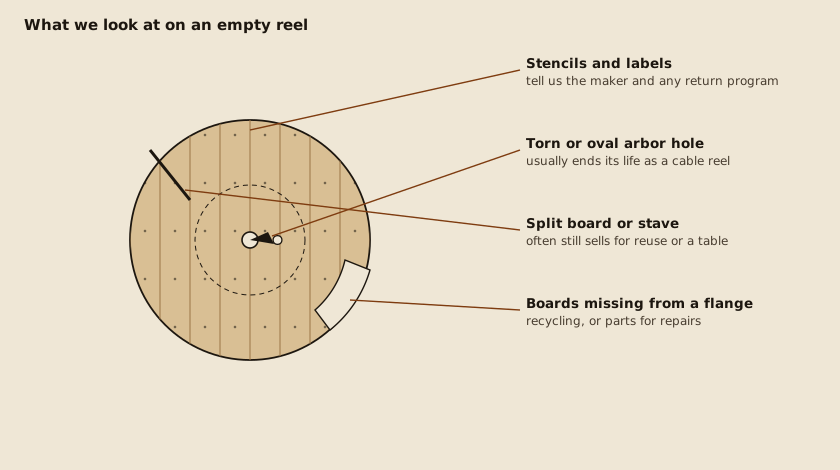
- Condition. Tight staves, square flanges and a round arbor hole mean a reel can carry cable again. Fail those, and the reel drops to table, ranch or recycling grade.
- Count and matching. Twenty identical reels are worth more than twenty mixed ones, because buyers want sets.
- Location and access. A stack beside a dock with a forklift costs little to collect. Reels scattered across a muddy yard with no machine cost a lot.
Worth money, worth reuse, or a cost
| Reel | Usually |
|---|---|
| Sound nailed reel, 30 to 72 in | Worth a payment, especially in matched sets |
| Sound nailed drum, 84 in and up | Valuable, but handling costs eat into it |
| Dry plywood reel in a matched batch | Small value, or free collection |
| Weathered or peeling plywood reel | Free collection at best; recycling |
| Plastic spool, sound | Free collection; small value in quantity |
| Broken, rotten or crushed reel | Costs money to move; recycling only |
| Returnable reel | Worth its deposit to whoever returns it to the maker |
Why a mixed load is often free
The sound reels in a stack offset the cost of taking the broken ones. On a typical jobsite load, that means the whole stack goes for nothing, or for a payment if the good reels are many. Only loads that are mostly broken, or tiny loads far from other pickups, tend to cost money.
Deposits change the maths
Some reels carry a deposit, paid when the cable was bought and refunded when the reel goes back. If your reels have a deposit, returning them to the maker is almost always worth more than selling them. Check the invoice and the stencils first. Our guide to returnable and one-way reels shows what to look for.
Why we don't publish prices
Two loads of fifty reels can be worlds apart: one all sound 48 in nailed reels by a dock, the other half-rotten mixed sizes in a field. A price per reel would be unfair to one of them. We'd rather look at a count and two photos and give a figure that holds.
Getting the best value
- Stand reels on their flanges, off the soil, and out of standing water.
- Keep plywood reels under cover.
- Keep matched batches together.
- Book a pickup before the stack has stood through a season.
- Send clear photos, including the worst reel, not just the best.
Timing the sale
Sound reels lose value the longer they sit outside. Selling them while they're freshly emptied, still dry and still tight, gets a better result than waiting for the end of a long project.
Questions
Are empty cable reels worth anything?
Sound ones in common sizes are. Broken ones aren't, but clearing them still has value to a site that needs the space.
Is a big reel always worth more?
Not always. A 96 in drum is valuable, but it costs much more to move than a 48 in reel.
Do brands matter?
Not to us. Brands matter to makers' return programs, not to the reel's reuse value.
Request a pickup or a quote
Count and flange size are the two things that matter. The rest helps us plan the truck.