Where big loads come from
Large counts tend to come from a handful of places. Data-centre campuses, with their long feeder runs and thousands of branch circuits. Substation and transmission jobs on utility networks; Oncor's 2025–2029 capital plan is $36.1 billion, and much of that work leaves reels behind. Wire and cable distributors clearing a yard after years of one-way reels. Reel-heavy plants and warehouses that have let a backlog build. In each case the reels are spread across a big area and mixed in size, and some of them have been standing long enough to need a closer look.
How a big load is planned
- Count by flange size. A rough count in each size band (under 36 in, 36 to 48 in, 60 to 72 in, 84 in and up) tells us how many trucks it takes.
- Photos of each area. Where the reels stand, how they're stacked, and how a truck gets to them.
- Loading equipment. Whether the site has a forklift with long forks, a telehandler, or nothing, which decides what equipment we bring.
- A plan in writing. How many trucks, over how many days, and what each one takes, so the site team knows what to expect.
- A final sweep. The last truck takes the broken reels, loose flanges and anything that turned up under the stack.
How many trucks
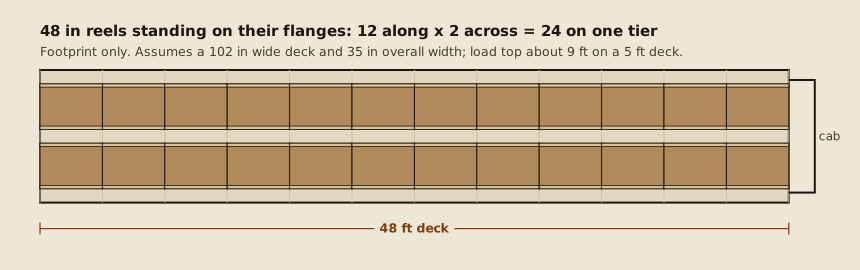
A 48 ft flatbed with a 102 in wide deck takes very different counts depending on the reel. Standing on their flanges in one tier, it holds roughly 96 reels of 24 in, about 48 of 36 in, about 24 of 48 in, and only around 6 of the 84 in or 96 in drums. Weight rarely runs out first with empty reels; deck space and load height do. So three hundred mostly 36 in reels might take seven or eight trucks, while three hundred mixed reels with plenty of large drums takes more. The flatbed guide has the full table and how we work it out.
Weights to plan for
Empty reels are lighter than people fear, but the big ones still need a machine. From the Okonite reel tables, a 36 in nailed reel weighs around 64 to 77 lb, a 72 in reel around 335 to 590 lb depending on width and build, and a 96 in drum 758 lb or more. See reel weights for the full range. Anything above about 60 in shouldn't be rolled by hand across a yard.
Keeping the site working
On a live site, big loads are best split into visits. Trucks arrive at agreed times, load one area at a time, and stay off the main haul road. If the site runs early starts or weekend work, we can plan around those. For a closing site or a yard that has to be handed back on a fixed date, tell us the date first and we plan backwards from it.
Records, receipts and leftovers
Large sites usually need paperwork. We can give a written tally per truck: date, reel count by flange size, and whether each group went on for reuse or to wood recycling. That's enough for most owners' closeout files and for contractors who track waste streams on a job. We don't estimate tonnage we haven't weighed or sign off on diversion percentages we can't support.
Big clear-outs also turn up surprises: a reel half full of cable at the bottom of a stack, steel reels a maker wants back, pallets of conduit fittings hidden behind the drums. We stop and ask about anything that isn't plainly an empty reel. Cable stays with its owner, steel reels are set aside, and loose materials stay on site for the contractor's own crews to deal with.
Questions
How soon can you clear a few hundred reels?
It depends on the count, the sizes and how the site can be loaded. We'll give you a plan with dates, not a promise we can't keep.
Can loading happen while the site is working?
Yes. Most big loads are cleared in visits that fit around the job.
Do you need the reels sorted?
It helps, but it isn't required. A rough count by size is enough to plan the trucks.
Request a pickup or a quote
Count and flange size are the two things that matter. The rest helps us plan the truck.