Strengths
- No rot. Rain, humidity and mud don't damage them the way they damage wood.
- Uniform. Every reel of a given model is identical, which suits automated winding.
- Light. Easier to ship and handle than a wooden reel of the same size.
- Clean. No splinters, nails or loose boards.
Weak points
Plastic gets brittle under sunlight and in cold weather. Hard drops crack flanges, usually near the hub, where the loads concentrate. Overloaded reels bow at the flange, then split. And a cracked plastic flange can't be repaired the way a wooden board can. Plastic reels also can't take the weights that wooden reels handle, which is why heavy cable stays on wood and steel.
Reuse first
Most plastic reels that come through the yard are in fine condition, because the cable they carried was light. They have a long second life: wire shops rewind cut lengths onto them, rope and cord sellers use them, makers and hobbyists want them, and farms use them for hose and drip line. That's almost always better than recycling, which depends on finding an outlet for the specific plastic.
Recycling
Plastic reels are made from several plastics, commonly high-impact polystyrene, polypropylene or ABS, and the type is often stamped on the hub. Each type needs its own outlet, and mixing them lowers what they're worth. We sort cracked plastic reels by type where the marking allows and send them to plastics recyclers that take that material. Where no outlet takes a particular plastic, we'll say so rather than claim otherwise.
Returnable plastic reels
Some heavy-duty plastic reels, particularly for fiber and some copper cable, are returnable to their maker. They're usually marked with the maker's name and a return notice. We set those aside rather than reselling them.
Storing plastic reels
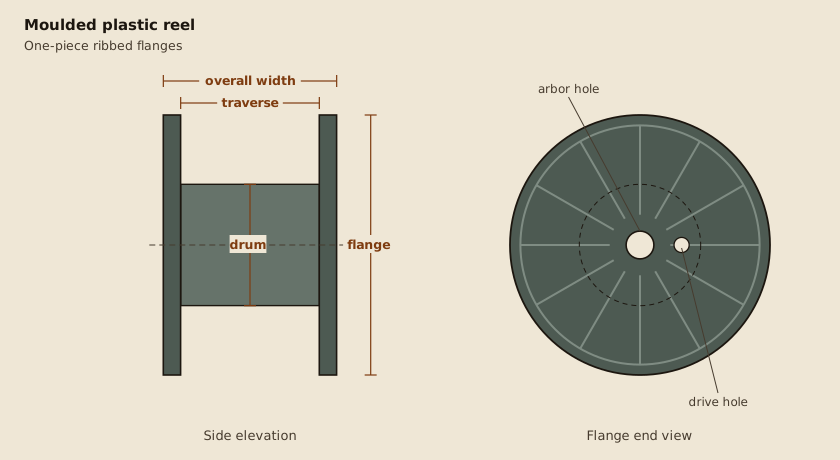
Plastic reels like shade. A season in full Texas sun fades and embrittles the flanges, so store them under a roof or a tarp if they'll sit for long. Stack one-piece spools hub to hub, or nest them if the design allows. Keep sectional reels assembled, because loose sections are easily lost or broken. Don't stack heavy objects on top of them: plastic creeps under constant load, and a flange that bows over a summer won't straighten again.
Telling plastics apart
Look for a recycling triangle or a code molded into the hub or the inside of the flange: PS or 6 for polystyrene, PP or 5 for polypropylene, ABS sometimes spelled out. A reel that flexes slightly when pressed is more likely polypropylene; one that feels glassy and stiff is more likely polystyrene. Mention the marks when you ask for a pickup, and we'll plan where the reels go.
Who leaves plastic reels behind
Fiber splicing crews, security and audio-visual installers, welding shops, appliance and HVAC technicians, and anyone pulling thermostat or alarm wire. In offices and data halls they collect in cable rooms and stairwells long after the installers leave, usually stacked against a wall until facilities staff ask for them to go.
Questions
Can plastic reels go in household recycling?
Usually not. Most city curbside programs take containers and packaging, not large rigid plastic reels. Check your city's rules.
Do you buy plastic reels?
Sound ones in common sizes, in quantity. Single small spools are usually collected with other reels rather than bought.
Why did my plastic reel crack in winter?
Cold makes many plastics brittle. A knock that a reel would shrug off in summer can split it in January.