Sizes and weights
Large reels are heavy enough that the plan for moving one matters as much as the reel. These weights for empty nailed reels come from the Okonite reel tables, and actual reels vary by builder and timber.
| Flange | Typical traverse | Empty weight | What it suits |
|---|---|---|---|
| 48 in | about 28 to 32 in | roughly 106 to 177 lb (45 and 50 in rows) | Large tables, hose reels, rope storage |
| 60 in | about 32 to 34 in | roughly 187 to 347 lb (58 and 62 in rows) | Ranch use, display, heavy cable |
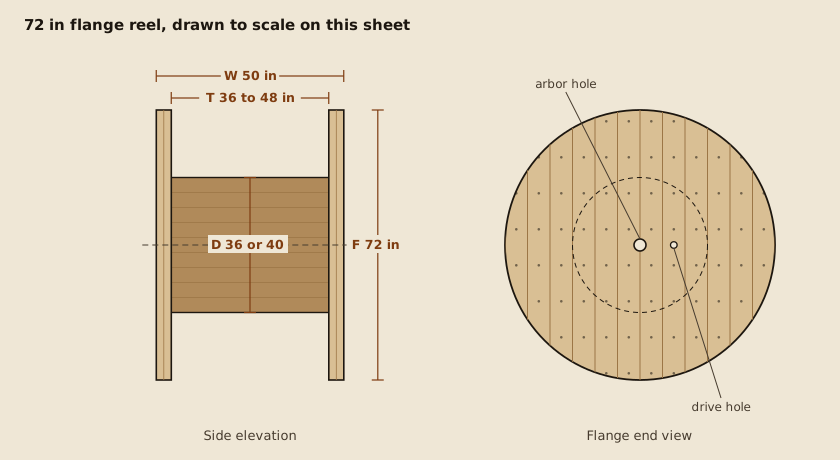
| 72 in | 36 to 48 in | 335 to 592 lb | Utility cable, rope and wire rope, feeders |
| 84 in | about 54 in | 639 to 920 lb | Medium-voltage cable, big ranch reels |
| 96 in | 48 to 54 in | 758 to 1,199 lb | Large conductor, signage, landmark pieces |
Okonite doesn't list exact 48 in or 60 in reels, so those rows quote the nearest sizes either side. Each reel's own size page has more: 48 in, 72 in, 96 in.
Who buys large spools
- Contractors rewinding medium-voltage cable, or stocking spare reels for pulls
- Rope and wire rope users storing long lengths for cranes, winches and rigging
- Ranches and farms using them for fence wire, poly pipe and hose, or as feeders and stands
- Restaurants, bars and venues wanting a big table or a statement piece
- Makers and builders who turn the wood into furniture, signs or outdoor pieces
- Events and film crews who need a few big props for a short time
Getting a big spool home
A 72 in reel won't fit in a pickup bed, and it shouldn't be rolled down a ramp without control. Most large spools are delivered on a flatbed and set down with a forklift or a winch, or rolled off a tilt bed with someone guiding each flange. If your site has no machine, tell us; we'll plan for it or suggest a smaller size that two people can manage. Our guide to moving large spools covers the risks, from rolling reels on slopes to tipping them onto a flange.
Condition on big reels
Large reels age differently from small ones. Their flange boards are thick enough to stay sound for years, but they're exposed to more weather, and the arbor plates can rust. We check each large reel for loose staves, cracked flange boards and a true arbor hole before selling it as ready to work. Those sold for tables or ranch use may have weathered faces or loose lagging, and we'll say so.
Using a big spool for cable or rope again
If a large reel is going back to work, three things matter more than looks. The arbor hole must fit the spindle or reel stand you'll use, and it must be round rather than worn into an oval. The flanges must sit square to the drum, or the cable will wind unevenly and the reel will wobble on its stand. And the drum staves must be tight, because a loaded 72 in reel puts a lot of weight on them. We sort reels for reuse on exactly those points. If you're winding something heavy or long, tell us the cable or rope, its diameter and the length, and we'll check the reel's capacity against it.
Availability
Large reels arrive when the jobs that use them finish: substation work, utility upgrades, data-centre feeders, cable plant clear-outs. Sometimes a single pickup brings in a dozen 84 in drums; sometimes none come in for weeks. If you need a specific size by a set date, ask early and we'll tell you how likely it is.
Questions
What's the biggest spool you can supply?
96 in reels turn up regularly. Larger drums exist, but they're rare and awkward to move; ask if you need one.
Can a large spool stand outside year-round?
Yes, with some care. Keep it off bare soil, stand it on its flanges, and seal the wood if it's a table.
Will a large spool fit through a door?
Rolled upright, a reel needs a doorway taller than its flange and wider than its overall width, meaning traverse plus both flanges. Many 48 in reels are too wide for a single door's clear opening, so measure before you buy.
Request a pickup or a quote
Count and flange size are the two things that matter. The rest helps us plan the truck.