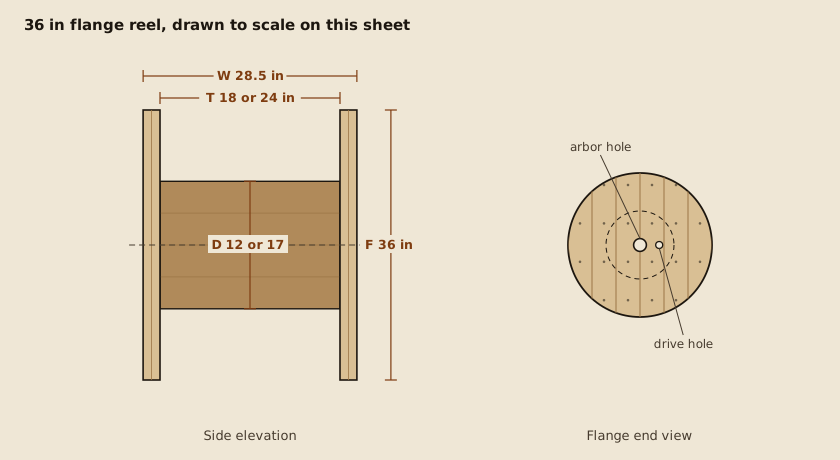
Rows read flange × inside traverse × drum. The narrow 36 in reel holds nearly as much cable by weight as the wide one: its smaller drum gives each turn of cable more room to stack.
Two builds, two uses
The narrow build, with an 18 in traverse and a 12 in drum, is the classic building-wire reel. The wide build, with a 24 in traverse and a 17 in drum, carries cable that mustn't be bent too tightly, since a bigger drum means gentler bends. When you're buying a 36 in reel to wind cable, the drum diameter matters as much as the flange: a cable with a large minimum bending radius needs the bigger drum.
Moving a 36 in reel
At 64 to 77 lb empty, two people can lift one into a pickup and one person can roll it on level ground. On grass or gravel, rolling is hard work; on a slope, it's dangerous if nobody's controlling the flange. A ramp and a hand on each side get it on and off a trailer safely. Forklifts make light work of a stack, and a single pallet jack won't help, since reels don't sit on pallets well.
On the truck
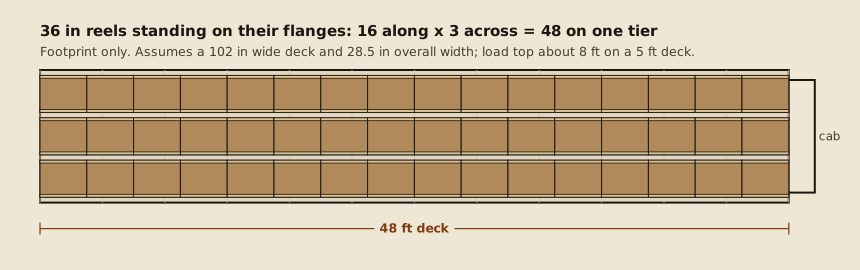
Standing on their flanges, the wide 36 in build, 28.5 in overall, fits three across a 102 in deck and sixteen along a 48 ft deck: about 48 in a tier. The narrow build, at 22.5 in overall, squeezes four across, about 64. A tier weighs roughly 3,000 to 4,100 lb, so weight is no problem; space is. Many loads put the 36 in reels in the middle of the deck with larger reels at the front and smaller ones stacked at the back.
The table size
On its side, a 36 in reel stands 22.5 to 28.5 in tall, depending on the build. The narrow one makes a coffee table; the wide one is close to side-table or low-dining height. The 36 in top seats two comfortably, three or four for drinks. It's the size most patio and bar tables are built from, and the size we're asked for most often by people furnishing a porch or a taproom. See a spool for a table for what to look for.
Ranch and workshop uses
A 36 in reel takes a 100 ft hose easily, a few rolls of barbed wire, or a long run of poly pipe for a stock tank. Mounted on a bar between two posts by the barn, it's a hose reel that won't crack in the sun. In a workshop it holds air hose, welding leads or extension cords and can be wheeled about on castors.
Selling 36 in reels
Sound nailed 36 in reels are among the easiest reels to sell on, because contractors, table builders and ranchers all want them. Plywood ones sell well too, if they've been kept dry. Mention the build, the count and whether they're the narrow or wide type; a photo of the drum end answers that at a glance.
What to check before reusing one
Spin the reel on a bar and watch the flange rims: a wobble means a flange has pulled away from the drum or the arbor hole has worn. Run a hand along the drum for split or sunken staves. Check the nails at the flange-to-drum joint, where most 36 in reels fail first, and look at the flange faces for forklift punctures. A reel that turns true with tight staves is fit for cable; one that doesn't can still make a good table.
How many we're likely to have
Because so many jobs empty them, 36 in reels are the size most likely to be available at short notice. Matched sets of a dozen or more in the same build are common. Plywood ones in good condition are scarcer than nailed ones, because they weather faster in yards.
A 36 in reel makes a handy cable stand at a jobsite gang box too, holding pull rope or temporary power cords off the mud.
Questions
How much does a 36 in reel weigh?
Between 64 and 77 lb empty for the two common Okonite builds, a little more or less for other makers.
How tall is a 36 in spool on its side?
Between about 22 and 29 in, depending on the traverse.
How much cable fits on a 36 in reel?
The Okonite builds are rated for 1,900 to 2,000 lb of cable. Footage depends on the cable.