Intermodal and distribution
Containers come into the intermodal terminal by rail and go out by truck to warehouses nearby. Those buildings are huge, modern and built for constant truck traffic. They were wired from reels during construction, and their tenants add more with each fit-out. Some freight also arrives on reels. Wilmer's pickups are mostly from these buildings: mixed loads after fit-outs, and reels left by contractors or previous tenants.
The inland port's five cities
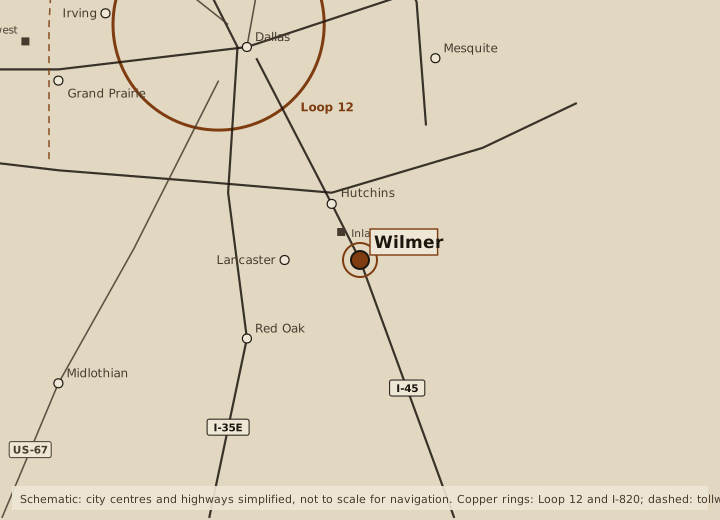
The International Inland Port of Dallas covers about 7,500 acres in Dallas, Lancaster, Hutchins, Wilmer and Ferris, between I-35, I-45 and I-20. A truck working the port can collect from all five in one run, which makes even small Wilmer loads easy to schedule.
Small town, big buildings
Beyond the warehouses, Wilmer is still a small community, with homes, churches and local businesses along its older streets. Homeowners there are spool buyers; local contractors and small businesses occasionally have a few reels to clear.
Pickup notes for Wilmer
- Distribution centres: gatehouse check-in, dock appointments and PPE.
- Truck traffic: I-45 and the roads around the terminal carry heavy truck traffic at all hours.
- Rail crossings: allow for trains near the terminal.
- Routes: shared with Hutchins, Lancaster, Ferris and southern Dallas.
What warehouse reels look like
| Reel | From | Usually |
|---|---|---|
| Nailed 36 to 72 in | Power distribution and feeders | Bought if sound |
| Plywood 24 to 36 in | Lighting, controls and data | Reused if dry |
| Plastic spools | Low-voltage and fire systems | Reused |
| Mixed and weathered | Left outside after handover | Recycled |
Clearing a building after construction
A new warehouse near the terminal is often finished by one contractor and leased by a tenant who arrives months later. In between, reels from the shell build sit in the truck court or behind the building. Leasing agents and property managers want them gone before tours and before the tenant's own fit-out crew arrives. Tell us the date the building needs to be clear, send photos of the reels, and we'll plan the pickup ahead of it. Shell-build reels are often sound nailed reels in mid sizes, so clearing them usually costs nothing.
Wilmer's older streets
Away from the big buildings, Wilmer's older streets are narrow, with ditches along the edges and soft shoulders after rain. A full flatbed can't always turn around there. For pickups or deliveries at homes and small businesses, a smaller truck works better, and we'll check the street on a map before sending one.
Ferris and the south end
South of Wilmer along I-45, Ferris holds the southern end of the inland port's footprint, with more distribution land opening up. Pickups there ride with Wilmer and Hutchins.
Equipment and conveyor installers
Conveyor, sortation and automation installers work building after building around the terminal, and they often leave reels of power and control cable at each one. If you're an installer finishing several buildings in a row, one pickup can clear them all on a single run.
A note on dust and wind
The open land around the terminal is flat and exposed, and dust and wind are constant. Plywood reels left out there weather fast, so earlier collection keeps them reusable.
Yard tractors and tight courts
Inland port truck courts are busy with yard tractors shuttling trailers between doors. Our driver checks in, follows the yard's traffic plan, and stays in the assigned spot until loaded, so pickups don't hold up shunting.
Wilmer's city hall, fire station and parks also see periodic upgrades that leave a few reels for collection.
Questions about Wilmer
Can you collect from intermodal-area warehouses?
Yes, once the tenant or owner releases the reels and arranges gate access.
Is a small load in Wilmer worth collecting?
Yes, combined with other stops around the inland port.
Do you deliver spools in Wilmer?
Yes, to homes and businesses on south Metroplex routes.