24 inch wooden spools and cable reels: dimensions, empty weight, cable capacity, how many fit on a truck, and who buys and sells them around Dallas-Fort Worth.
30 inch wooden spools: dimensions, empty weight and rated cable load from the Okonite tables, truckload counts, uses as coffee tables, and selling or buying them in DFW.
36 inch wooden spools and cable reels: the two common builds, weights and rated cable loads, truckload counts, and their uses for cable, tables and ranch work around DFW.
42 inch cable reels: dimensions, empty weights and rated cable loads, why this size needs a ramp or a forklift, truckload counts, and selling or buying them in Dallas-Fort Worth.
48 inch (4 ft) wooden spools: dimensions and weights from the nearest Okonite reel sizes, rated cable loads, truckload counts, handling, and buying or selling them in Dallas-Fort Worth.
60 inch (5 ft) cable reels: weights and rated cable loads from the nearest Okonite sizes, how many fit on a flatbed, handling by machine, and where they're used around Dallas-Fort Worth.
72 inch (6 ft) cable reels: five Okonite builds with weights from 335 to 592 lb and rated loads to 8,000 lb, flatbed counts, load heights, and their uses around Dallas-Fort Worth.
The sizes side by side
| Flange | Common traverse and drum | Empty weight | Rated cable load | On one 48 ft flatbed tier |
|---|---|---|---|---|
| 24 in | 12 or 18 in, 10 in drum | 23 to 24 lb | 350 lb | about 96 |
| 30 in | 18 in, 12 in drum | 39 lb | 950 lb | about 76 |
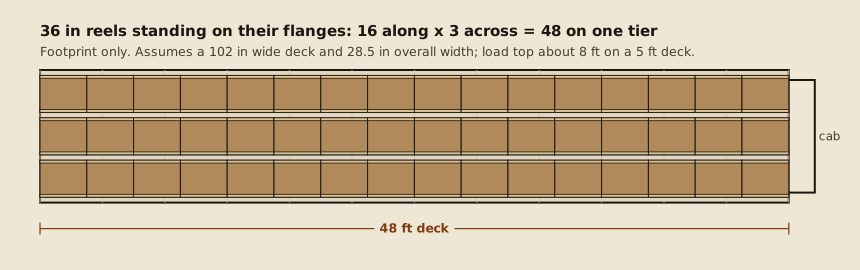
| 36 in | 18 or 24 in, 12 or 17 in drum | 64 to 77 lb | 1,900 to 2,000 lb | about 48 |
| 42 in | 26 in, 18 in drum | 90 to 100 lb | 1,500 to 3,000 lb | about 39 |
| 48 in | no exact row; 45 and 50 in rows either side | 106 to 177 lb | 1,500 to 4,800 lb | about 24 |
| 60 in | no exact row; 58 and 62 in rows either side | 187 to 347 lb | 3,000 to 7,000 lb | about 18 |
| 72 in | 36 to 48 in, 36 or 40 in drum | 335 to 592 lb | 4,500 to 8,000 lb | about 16 |
| 84 in | 54 in, 48 in drum | 639 to 920 lb | 6,000 to 12,000 lb | about 6 |
| 96 in | 48 or 54 in, 48 or 56 in drum | 758 to 1,199 lb | 6,000 to 15,000 lb | about 6 |
Dimensions, weights and rated cable loads: The Okonite Company, Technical News Edition 33, "Reel Anatomy", November 2016. Flatbed counts are our own arithmetic for reels standing on their flanges on a 48 ft by 102 in deck.
Reading the table
Okonite often lists two reels with the same flange, traverse and drum but different weights. The heavier one is a stronger build, rated for roughly twice the cable. So a 72 by 36 by 36 in reel comes at 335 lb rated for 4,500 lb of cable, or at 559 lb rated for 8,000 lb. When you buy a reel to carry cable, the rated load matters more than the flange size; when you're moving empties, the empty weight is what counts.
Three size bands
- Hand reels, 24 to 36 in. Two people can lift, roll and load them. They fit in a pickup bed. Most building wire and light cable arrives on them.
- Ramp reels, 42 to 60 in. Too heavy to lift, light enough to roll up a ramp with care. A forklift makes them easy.
- Machine reels, 72 in and up. Forklift, telehandler or crane only. They carry utility, medium-voltage and heavy cable.
Measuring a reel you have
Measure across one flange from rim to rim, through the centre: that's the size. Then measure the inside traverse, between the flanges, and the drum diameter, if you can see it. Those three numbers identify a reel. Our guide to measuring a reel shows where to put the tape, and flange, traverse and drum explains why each one matters.
Sizes we see most in the Metroplex
The 36 and 48 in sizes turn up constantly. The 24 and 30 in reels come in big batches from distributors and data-cable jobs. Reels of 72 in and up arrive in fewer numbers, mostly from utility work, substations and data-centre feeders.
Choosing a size to buy
Start from the job. For winding cable, work out the cable's weight per foot times the length, and pick a reel whose rated load covers it, with a drum no smaller than the cable's minimum bending diameter. For storing rope or hose, measure the coil and choose a traverse it fits inside, with a few inches of freeboard below the flange rim. For a table, pick by height first: the reel's overall width becomes the table's height when it lies on its side. And for ranch work, choose something you can actually move with the equipment you've got, because a reel you can't shift is a reel you'll leave where it fell.
Why there's no single standard
Reel builders work to their customers' specifications, not one national size chart. A wire maker orders reels that suit its cable lengths, its winding lines and its trucks, and two makers' 48 in reels can differ by several inches of traverse and dozens of pounds. Published tables like Okonite's are a good guide to the typical spread, but measure the reel in front of you when the numbers matter. Rough dimensions are fine for a pickup quote; exact ones matter for winding cable or ordering matched reels.
Sizes outside this range
Smaller spools, under 24 in, are mostly plastic or light plywood and are covered on the empty wire spools page. Reels bigger than 96 in exist, such as Okonite's 108 in drums at about 1,800 lb, but they're rare on DFW jobs and need specialist transport.
Questions
What's the most common reel size?
Nailed reels of 36 to 48 in are among the commonest on Dallas-Fort Worth jobsites, because so much building wire and feeder cable ships on them.
Is a 48 in reel the same as a 4 ft reel?
Yes. Reels are sized by flange diameter, and 48 in is 4 ft.
Do sizes differ between makers?
Yes, slightly. Two 48 in reels from different builders can have different traverses, drums and weights.