Why contractors want them
Pulling several conductors into the same conduit at once is standard practice, and it's easier when they come off one reel. A compartmental reel saves setting up three or four separate reels on stands, keeps the conductors paying off evenly, and cuts the number of empties left at the end of a job. Distributors use them to supply a matched set of conductors cut to the same length.
Reusing compartmental reels
Used compartmental reels have a small, steady market. Contractors who cut their own feeder sets want them, and distributors that make up multi-conductor pulls for customers will take sound ones. The checks are the same as for any reel, with one more: the inner flanges must be tight and square to the drum, or the cables will rub against each other as they unwind.
Telling a compartmental reel from a stack of reels
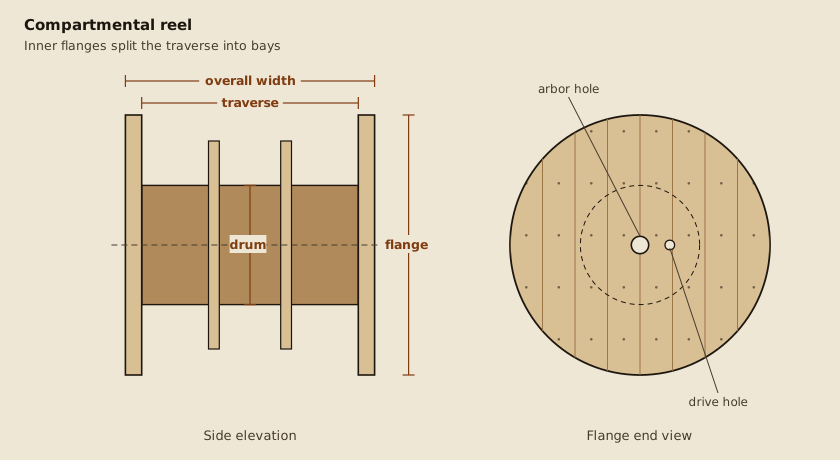
On a laydown yard, a compartmental reel can look like two reels standing side by side. Look along the drum: if one continuous drum runs through all the flanges, it's compartmental. If each section has its own drum and its own arbor hole, they're separate reels. The arbor hole runs right through a compartmental reel, so one bar or spindle carries the whole thing.
Repairs and recycling
Inner flanges take a beating when cables are pulled hard and unevenly, and they're the first part to crack. On a large reel, a cracked inner flange can be replaced; on a small one, it's rarely worth it. Damaged compartmental reels are recycled like other wooden reels, with the extra flanges and any bolts removed first.
Buying one
Tell us how many compartments you need, the cable sizes and lengths, and the flange size if you know it. We'll tell you whether we have something close. Supply is irregular, because compartmental reels come in only when a job that used them finishes, so give us as much notice as you can.
Paying off from a compartmental reel
Set the reel on a stand or jacks with a bar through the arbor hole, level it so each cable leaves its compartment squarely, and feed the conductors into the pull together. Watch the compartments as the pull goes on: cables of different diameters empty at different rates, and the smallest one may run out before the others. A brake or a person on the flange keeps the reel from overrunning when the puller stops. If one conductor binds, stop the pull before it scrapes against an inner flange and nicks its insulation.
Where they turn up in DFW
Compartmental reels appear most often on commercial and industrial jobs with lots of parallel feeders: data-centre electrical rooms, hospital expansions, distribution warehouses with large service entrances, and plant upgrades. Electrical distributors that offer cut-and-paralleled cable sets to contractors also handle them regularly, and some keep their own fleet that they expect back.
Weight and capacity
A compartmental reel's capacity is the sum of its compartments, each worked out like a small reel of its own. The extra flanges add weight and take a little traverse, so a compartmental reel holds slightly less cable than a plain reel of the same outside dimensions.
Selling compartmental reels back
If your company has a few compartmental reels left after a project, they're worth mentioning separately when you ask for a pickup quote. They're scarcer than plain reels of the same diameter, and a sound one with tight inner flanges often has a buyer lined up. Photograph the drum between the compartments, because that's where hidden damage hides: crushed staves, splits beside an inner flange, or nails that have backed out. Measure each compartment's width too, as buyers ask about it before anything else.
Builders sometimes add inner flanges to large drums for paralleled medium-voltage runs, so compartmental designs aren't limited to small reels.
Label each compartment's cable at the reel end as the pull is set up; it saves confusion when conductors come off at different rates.
Questions
Are compartmental reels returnable?
Some are, especially from distributors that make up cable sets. Check for stencils.
Can I make a compartmental reel from an ordinary one?
It's possible to add an inner flange to a large wooden reel, but it needs care to keep it square and secure. Buying one is usually simpler.
What size compartmental reel do I need?
That depends on each cable's outside diameter and length. Tell us those and we'll suggest a size.