The common spool sizes
| Flange | What they're used for | Notes |
|---|---|---|
| Under 12 in | Small-gauge wire, cord and welding wire | Almost always plastic |
| 12 to 18 in | Cut lengths of building wire, rope and chain | Plastic or plywood |
| 24 in | Building wire, service cable, garden hose | The Okonite tables list 24 by 12 by 10 in and 24 by 18 by 10 in reels at 23 to 24 lb |
| 30 in | Feeder offcuts, drip line, fencing wire | A 30 by 18 by 12 in reel weighs about 39 lb |
| 36 in | Larger cable, side tables, ranch hose | 64 to 77 lb in the two common builds |
Our pages on the 24 in and 36 in sizes go into more detail on each.
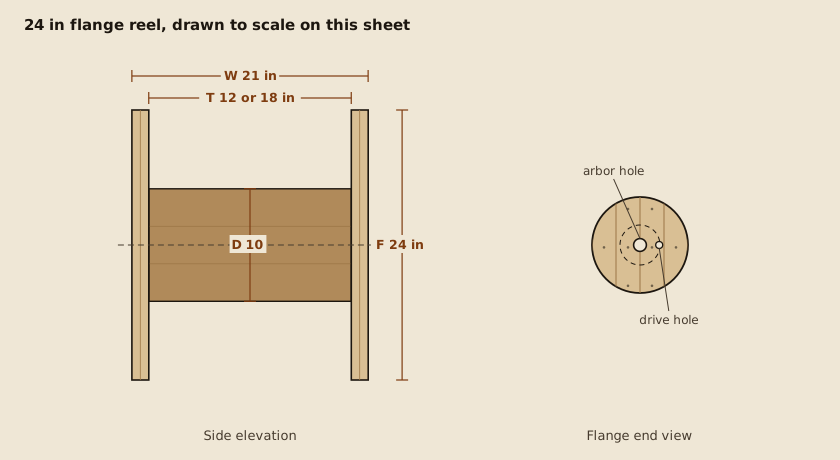
Plywood or plastic
- Plywood spools are two plywood flanges bolted through a drum. They're light, cheap and easy to handle, but they don't like rain; water gets into the flange edges and the layers start to separate. Keep them under cover.
- Plastic spools shrug off weather, nest neatly and come in fixed sizes, but they're brittle when cold or overloaded, and a cracked flange can't be repaired.
- Small nailed reels are the toughest of the three and the heaviest. They suit outdoor use and heavier wire.
The plywood reel and plastic reel pages compare the builds in more detail.
Who buys empty spools
Electrical supply counters and contractors who sell or carry cut lengths of wire. Rope, chain and cord shops. Welders and fabricators storing wire. Farms and nurseries winding drip line or hose. Florists, event planners and makers, who use the smallest spools for displays, tables and stands. Sellers at markets who need something sturdy for a stall. Anyone who's ever tried to store 200 ft of extension cord neatly.
Buying in quantity
Small spools are easy to supply in bulk because they come in bulk: a single data-cable job can release dozens of identical plywood spools. Tell us the size range, the build and how many you need. We'll pack them on pallets or in gaylord boxes for delivery, or have them ready for you to collect.
What to check on a spool
The arbor hole should be round and clean, so the spool turns on a bar or a stand. Bolts on plywood spools should be tight. Plastic flanges should be free of cracks, especially around the hub where the stress is greatest. A spool you'll only use for display just needs to look right, and those are cheaper.
Spools for wire you sell
If you rewind wire onto spools for customers, consistency matters more than condition. Mismatched spools are awkward on a rack and harder to price. We'll keep a batch together wherever possible, and say if it's mixed between builds or makers.
Turning a spool into something else
Small spools make good projects because they're light and simple. A 24 in plywood spool with a sanded top and a coat of exterior varnish is a sturdy plant stand. Stack two of different sizes on a dowel and you have a tiered display for a market stall. Spools with the drum boxed in become low bookshelves or bedside tables. A spool mounted on a pipe through its arbor hole, on a pair of brackets, makes a wall-hung reel for twine, rope or cord in a shop. The bolts on plywood spools are long, so check where they are before you drill or cut.
Storing spools you've bought
Keep plywood spools dry and off concrete floors that sweat in humid weather; a pallet underneath is enough. Plastic spools stack inside one another if the hubs nest, which saves floor space. Nailed spools can stand outside, but stand them on their flanges so water doesn't pool on top, and turn them now and then if they sit for months.
Questions
Do you sell single small spools?
Yes, though it's often easier to collect a single small spool than to have it delivered alone.
What's the smallest spool you have?
Plastic spools under 12 in come through regularly. Thread, ribbon and filament spools aren't something we handle.
Can spools be used for garden hose?
Yes. 24 to 36 in spools hold a typical garden hose comfortably, and a bar through the arbor hole turns them into a hose reel.
Request a pickup or a quote
Count and flange size are the two things that matter. The rest helps us plan the truck.